
In the wake of Nevermind’s historic spew and cry, the world embraced ?the dark side, and then it didn’t. Will it ever again?
“Smells Like Teen Spirit” started as a joke, was misinterpreted as a revolutionary message, became recast as the ultimate alienated teen anthem, bloomed into a successful crossover hit, and ultimately caused no end of grief for the band that created it. In a sense, Nevermind‘s most famous single is a Greek tragedy played out over 16 bars.
Fittingly, Nirvana’s ascent to pop stardom and enshrinement in rock history occurred at a specific moment, when America’s disaffected youth inherited a terrible economy, a trashed environment, and shattered fantasies of nuclear families. Appearing against this backdrop, Nevermind was an album crammed full of angst, inner struggle, and contempt for the society that had pushed America to the brink of collapse. As song after song from the album entered heavy rotation on the radio and MTV, Nirvana reached millions of people who saw themselves as outcasts, and who began to sense some sort of redemption in the bass line of “Come as You Are.”
Unfortunately, while Nevermind has endured as a musical achievement, the widespread disquiet that allowed the album to penetrate society so deeply appears to be over. Agitated, introspective, ambiguous lyrics flickered prominently in the pop mainstream, but were totally eclipsed by the end of the 1990s, when the relentlessly peppy sounds of boy bands and teen queens began to rule the charts. The idea of pondering the wider world in a pop song fell away as the Internet’s seductive pool encouraged young narcissists to drown in their own reflections. Bland smiles replaced wry smirks.
Also Read
Kurt Cobain Forever
So what made skepticism, political awareness, and soul-searching so uncool? And what happened to the lost generation that related so intensely to Nirvana? In order to figure out why teenage angst “paid off well,” as Kurt Cobain put it post-Nevermind, but then virtually disappeared from pop culture for 20 years, we need to start further back.
Pop music was an essential part of the social revolution that rocked America in the ’50s and ’60s, helping bring an end to segregation and fuel feminism’s second wave. Artists historically denied entry to America’s mainstream suddenly were cracking those boundaries. Musical crossover — via jazz, Motown, etc. — was its own form of integration. Then during the ’60s and ’70s, movements even further outside of the white American mainstream were thrust into the limelight.
In his remarkable 1988 movie Hairspray, filmmaker John Waters used protagonist Tracy Turnblad’s ’60s teen dance-show aspirations as a way to examine turbulent race relations. Based on events in Waters’ hometown of Baltimore, Maryland, Hairspray dramatized the controversy around the real-life Buddy Deane Show (renamed The Corny Collins Show), a major battleground for racial integration among Baltimore’s teens. In the film, Tracy and her friends win the fight, broadcasting images of black and white kids happily dancing together — in reality, the Buddy Deane Show went off the air rather than integrate.
Following this period, the ’70s came in on a wave of glitter, dancing, and polyester, as doors opened for Americans previously deemed unwelcome as loud-and-proud leaders of pop music. Disco exploded, with divas testifying about love and loss in songs that became anthems for gay men (many of whom were the creators of the music itself). Salsa also emerged in the ’70s, helping to introduce America to Latin culture. But some factions feared the changes represented by these movements, blaming various groups for contributing to the country’s economic and social disintegration. As a result, the culture swerved conservative, extolling so-called “family values,” a return to the idea of a homogenized nation, and above all, financial security. Punk and hip-hop were brewing, but their mainstream impact was a few years off.
Very quickly, the ’80s devolved from self-righteous puritanism to a drugs-and-money bacchanal, with Americans getting high on fleeting prosperity — until the bubble burst. Regular citizens were left holding the bag as the economy slid into recession, and we started to reevaluate where a culture based primarily on consumption would ultimately lead.
“Nevermind was really the voice of that generation who didn’t buy what [President Ronald] Reagan had tried to sell,” says Laina Dawes, author of the upcoming book What Are You Doing Here? Black Women in Metal, Hardcore and Punk. “They didn’t want to become their parents, who they felt had sold their souls for a rigid conformity that the youth could see was a bullshit existence.”
Jack Davey, of Los Angeles-based alternative R&B/rock duo J*Davey (who released a stirring version of “Smells Like Teen Spirit” earlier this year), cites “a kind of newfound independence” that defined the late ’80s and ’90s. “People who were teenagers at that time were kind of rebelling against a lot of the economic oppression,” she says. “There were a lot of conventions in the ’80s that were worth rebelling against.”
While political affiliation largely determines how one perceives the public policies of the ’80s and ’90s, it is undeniable that Reagan’s trickle-down economic plan, mass deregulation of industry, cuts to education, food stamps, and environmental protection shook the nation. National poverty spiked, driven by corporate layoffs and lethargic hiring practices. According to the Census Bureau, from 1992 to 1993, the number of American citizens living in poverty rose from 14.8 to 15.1 percent, meaning that 39.3 million Americans lived in households eking by on less than $15,000 a year. The white-collar American dream, largely the foundation of our country’s mythology, looked increasingly out of reach.
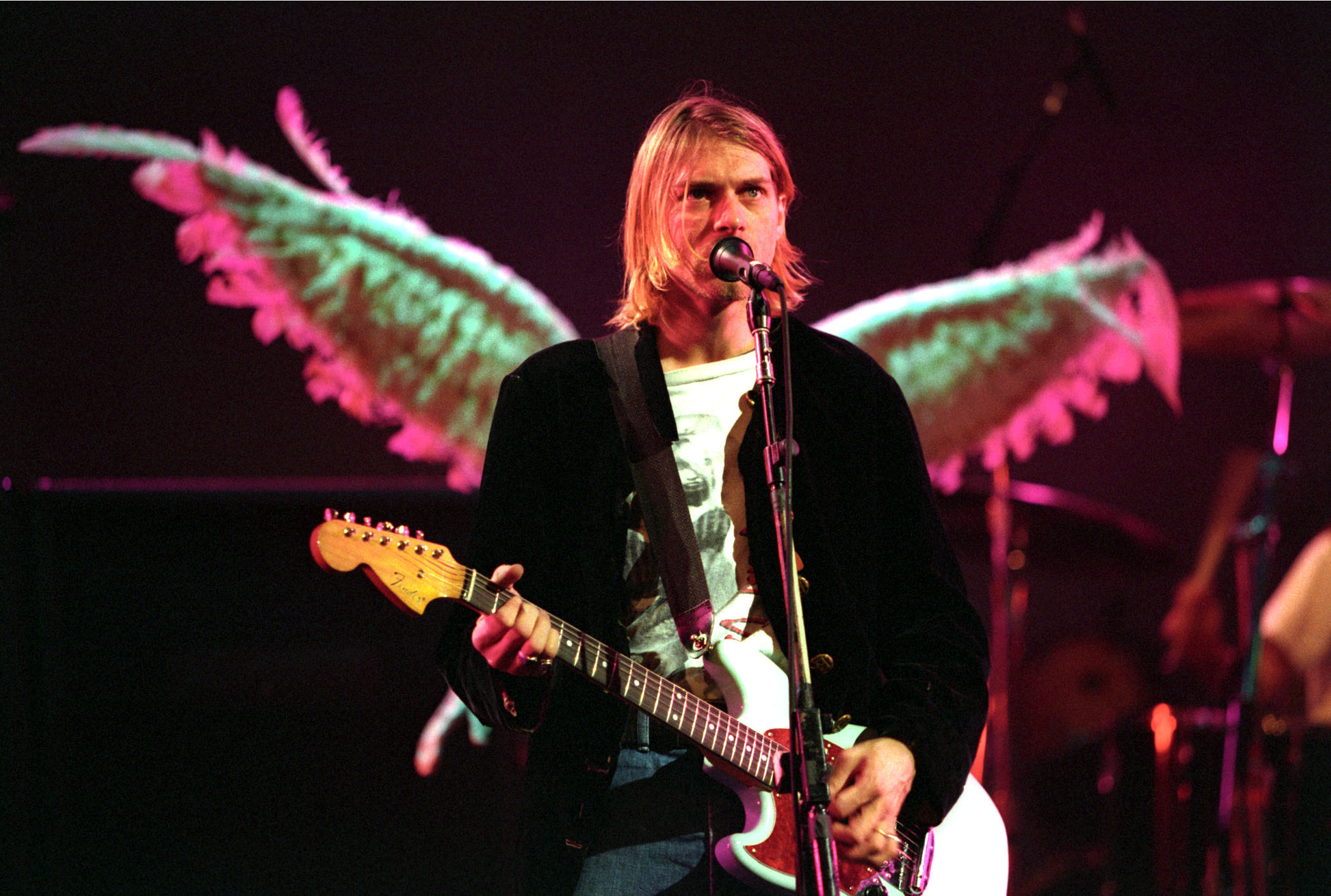
Nirvana, photo by Michael Lavine
Jeff Chang, author of Can’t Stop Won’t Stop: A History of the Hip-Hop Generation, recalls how this decline was often interpreted as a failure of Generation X (generally defined as those born from the mid-’60s through the ’70s). “There was literally a story in The Atlantic in the early ’90s with a white dude wearing his baseball cap backwards [on the cover],” Chang says. “It was about how this new generation is fucked in the head, downwardly mobile, and angry. At the same time, these movements that were underground were all about to blow.”
One other more major factor during the early ’90s pushed the culture toward a grimmer, rebellious view of the future — the Gulf War. Heavily televised images from Operation Desert Storm and speculation about reinstating the draft had a huge impact on kids coming of age at the time. “We knew the war was ridiculous, it was all BS, and there wasn’t anything you could do about it,” says Allison Wolfe, cofounder of riot grrrl band Bratmobile. “Then there was the whole draft thing, and all the guys I knew were freaking out.”
In the midst of all this national drama, teens and young adults latched on to ’90s pop culture as a life preserver — and it actually delivered its own salvation.
About the same time that Nirvana’s “Lithium” challenged ideas about the inner self and religion, another song crept into the mass consciousness — Radiohead’s “Creep,” a four-minute wail of anguish and longing that tapped into every kid’s hidden fear of alienation and became a pop crossover. However, in an interview with the Boston Globe in 1993, Thom Yorke revealed that the tune was actually about “being a man in the ’90s.”
“Any man with any sensitivity or conscience toward the opposite sex would have a problem,” says Yorke. “It is one of the things I’m always trying: to assert a sexual persona, and on the other hand, trying desperately to negate it.”
Meanwhile, feminism was being loudly maligned, a sentiment documented by Susan Faludi’s book Backlash: The Undeclared War Against American Women. As a result, more female artists began to overtly defend themselves, whether it was TLC boldly creepin’ for the affection they didn’t get from their cheatin’ boyfriends, Tori Amos raising her voice against being crucified (and whisper-singing the tale of her rape), or Salt-N-Pepa defiantly informing the world that their sex lives “ain’t none of your business!” As the ’90s went on, Lil’ Kim and Foxy Brown took fuck-me feminism to a whole other level, Alanis Morissette told a former lover what he oughta know, Meredith Brooks celebrated her bitchitude (as a way to claim her humanity), and Lauryn Hill redefined black womanhood.
Frannie Kelley, editor of NPR’s The Record blog, recalls that despite the progress made by women, many still had to deal with negative stereotypes that men didn’t. This is illustrated in many ways by the public perceptions of Cobain and Hole lead singer Courtney Love, Cobain’s wife up until his death. “She was messy and angry and people hated her,” says Kelly. “He was messy and sad and people loved him.”Continue reading ‘Teen Esprit Revisited’ on page 2 >>
Cobain became not just the frontman for Nirvana, but a frontman for the whole ’90s debate about masculinity, femininity, and sexual identity that was going on across pop culture. In Nirvana’s heyday, he was known for wearing dresses, lipstick, and nail polish in an attempt to queer his own image and ridicule rock’s still-primitive views of male sexuality. In 1994, My So-Called Life introduced the world to Rickie Vasquez, a gay teen icon who wore eyeliner, labored under the weight of unrequited crushes, and sought to name his own identity. Watching Rickie kneel in snow stained with his own blood, beaten and homeless, during the holiday episode “So-Called Angels,” was a pivotal moment for many teens. While queer kids have been told for the past year that “it gets better,” Rickie Vasquez embodied that struggle — and the reality that a better life was just a few years off.
Even animation was grappling with larger questions of meaning and identity. In 1991, MTV debuted Liquid Television, an experimental showcase for vignettes on random topics. “Art School Girls of Doom,” for example, featured self-referential humor and two main female characters played by actors in drag. The show birthed two iconic ’90s series: Mike Judge’s so-asinine-it-was-awesome Beavis and Butt-Head and Peter Chung’s Æon Flux, a series of moody, brooding sci-fi cartoons that directly attacked ideas of duty to God or country. Æon also worked as a critique of the general narrative structure and deeply held conventions of Hollywood movies, which clearly delineated a hero and a villain, manipulating audiences to feel emotionally attached to a character based on societal cues. Chung positioned the heroic action scenes in Æon Flux as mostly foolish and accidental, placing characters in situations that existed far outside the boundaries of typical morality.
Nirvana, shot by Kirk Weddle
Chung’s belief in challenging the viewer was a ’90s ethos — pop culture for teens was smart. There was an assumption that audiences could handle an errant reference to, say, Jean-Paul Sartre’s No Exit — in fact, another MTV animated series, Daria, featured a misanthropic teenage girl as its lead character, and explicitly played on Sartre’s central ideas. But by the time the national economy seemed to rebound in 1998, pop culture had started to move away from the darker motifs of the ’90s voiced by Nevermind and Æon Flux. Instead, a new wave of imagery arose, based around boy bands and Britney Spears.
Spears couldn’t have been a greater contrast to the women who defined the 1990s. The unapologetically sexual, fierce sound of female braggadocio was everywhere, from MC Lyte and Queen Latifah to Liz Phair and PJ Harvey. Spears, held aloft as a symbol of purity and virginity, represented a shift away from everything those women stood for. Spears was soon joined by Christina Aguilera, Jessica Simpson (who also promoted her virginity), and Mandy Moore (who would later wince at her “Candy” years). With a sugary dance-pop sound, the teen superstars kicked angst to the curb, swapping reflection for a glossier 2000 edition of the teen dream.
Mediaite editor Alex Alvarez explains why the portrayal of cool in Nevermind and its accompanying videos — sardonic, anticorporate, defiant — was destined to be short-lived: “When Britney and the boy bands rose up, it was a return, or a continuation, really, of a teenage experience that was more aspirational — “I want to be like / I want to be with this person” — and, as such, more marketable. You can’t really make a buck off flannel shirts from the thrift store.”
Allison Wolfe sees larger forces at play. “People in power don’t like to feel like they are out of control,” she says. “In the early ’90s, there was so much energy, a kind of rebel spirit in all of these things. But mass culture has to control that, defang it, declaw it, and spit it back out as a product.”
Commercialism certainly played a role in removing discontent from the pop-culture mainstream, but another factor also emerged — the Internet. Suddenly, message boards, chat rooms, and Angelfire sites were having just as much, if not more, impact as concerts, zines, and TV shows. Young people could connect to others outside of their physical space, so all the black kids who felt like the only ones in their world with Nevermind on repeat — and all the white kids relating to Tupac’s and Biggie’s struggles from afar — suddenly had access to others in similar situations. The existence of a widely populated online world irrevocably transformed the way that we experience, understand, and ultimately create pop culture. Nevermind was decidedly pre-Internet.
Still, the album’s angst did eventually filter into cyberspace and the pop mainstream, but in a restyled mold — emo. With an army of pretty boys wearing guyliner and their hearts on their sleeves, emo took wide-ranging indignation and narrowed it down to lyrical navel-gazing. As Jessica Hopper wrote in the zine Punk Planet, emo put the focus completely on the individual, creating “songs and scenes populated with myopic worldviews that do not extend beyond their velvet-lined rebel trauma, their bodies, or their vans.” Alienation simply became a matter of fashion and lifestyle.
Or maybe the disaffection represented by Nevermind just simply died out because of cultural fatigue. After years of poverty and war, it was only logical for large segments of the nation to crave escape. Rap became shinier and flossier, with sparkly suits, bottles of Cristal, and gold-studded grills. Rock lost Billboard chart space to a teen-pop onslaught free of outcast stigma. By the late ’90s, MTV moved on to more disposable programming, from game shows (Singled Out, The Blame Game) to an increasing number of reality shows (Jackass, Road Rules), building off The Real World‘s success. So, the culture fled from the darkness. Perhaps that’s part of evolving as a society. Mary J. Blige, whose career took off during the time of Nevermind’s boom, was known for her lyrical and public battles with addiction; then she symbolically killed off her former persona to move forward in her life.
Jeff Chang points out that abandoning a certain lifestyle doesn’t mean abandoning one’s core principles. “We [the generation that came of age in the ’90s] are the motherfuckers who invented social media, we’re the motherfuckers all up in the Obama administration trying to make it cool,” he says. “People found an outlet for their rage that would be living — as opposed to Kurt ending up on the floor in his mansion.”
Perhaps angst isn’t dead, but rather, it’s simply being redefined. The rise of the digital realm, the ubiquitous nature of media in general (cable, satellite, video games), plus a more universal acknowledgment that any definition of American culture depends on one’s particular perspective, has resulted in an era when it’s not possible for cultural life preservers, like Nevermind, angsty or otherwise, to bob up and stay afloat in the sea of pop culture. Now there are just smaller islands in a much larger ocean. But this too will change.
Our current reality is the result of the turbulence of the ’60s, ’70s, ’80s, and ’90s. With so many divergent forces swirling, it’s hard to even recognize historic shifts as they happen. Now that we’ve abandoned the idea of a unified culture for our own fast-forward fiefdoms, we may well be on a Titanic-style collision course with the next Nevermind. It might be another epic album or generation-defining movie. Or maybe it’s something that hasn’t even been invented yet, something beyond social media that will tie us all together.
And maybe, we’ll all be so preoccupied that we won’t even recognize it until after the moment has passed.
BUY THIS ISSUE
Read the entire August 2011 issue of SPIN, available now for iPad.