Masterminds Mark Mothersbaugh and Jerry Casale (with a little help from Josh Freese) trace the evolution of the de-evolutionists. [Magazine excerpt]
1. FROM HIPPIE TO HIPSTER – THE JERRY CASALE WAY
At Kent State, the Devo cofounder was a member of Students for a Democratic Society and attended the tragic May 4, 1970 protest where unarmed students were fired upon by the National Guard. Two of the four slain were friends of his.
Casale: “That solidified brute power winning out over truth. They got away with murder. When you live through that and see the newspapers are a complete and utter lie, you realize that’s the real world. I wouldn’t have been into a Devo aesthetic if that hadn’t happened to me.” He then shed any trace of counterculture style he may have associated with peace and love. “I cut my hair, got rid of my flared pants and velour shirts, and went to this pimp store in Cleveland, where I bought straight-legged pants, high, black shoes, and a long leather jacket, like you’d see the Black Panthers wearing.”
2. NEVER TOO MUCHMONKEY BUSINESS
In the mid-’70s, Casale divided his time between the unknown Devo and the blues band 15 60 75, which was famous throughout northeast Ohio.
Casale: “Mark and I had started buying masks. One time I brought a full-head rubber ape mask with me to a 15 60 75 gig and slipped it on before we did that Bo Diddley song ‘You Can’t Judge a Book by Its Cover.’ The people that were dancing stopped cheering for the band, started pointing, and [frontman] Bob Kidney turned around and saw me in the mask. I got fired. That helped me get more serious about Devo.”
3. A TWISTED PRAIRIE HOME COMPANION
Casale: “Everybody had a whacked-out sound. There were no normal sounds on any of the instruments. They had all been tweaked. What you hear on the Hardcore Devo CD is how we would sit around in a living room in 1974 or ’75. Mark would have a Minimoog on a table and an ARP Odyssey [synth], I would have a Gibson bass and a tiny amp, Jim Mothersbaugh would have his electronic drums, and Bob Mothersbaugh would have a guitar coming through a little Champ [amp]. And we would write songs and play them…”
Mothersbaugh: “You’re making it sound like Lake Wobegon.”

4. SURVIVING THE SCENE
Mothersbaugh: “There were two places we could perform without fear of a fistfight or just being paid to quit. That was Pirate’s Cove in Cleveland, where 35 hardcore people would show up, and the Crypt in Akron, where we always had 20 friends and four guys wanting to beat us up. When you’re that ostracized and disenfranchised in your peer group and in your local culture, you turn unfriendly back. I know we didn’t appear to be friendly, but it was self-defense. It was part of our manifesto to separate ourselves out; we were more like aliens making satirical comments on the culture. We took pleasure in being lightning rods for hostility and freaking people out.”
5. VIDEO NOW FOR THE FUTURE
Casale: “People forget, we did play rock’n’roll. The emphasis got put elsewhere in the public image and the press. But nobody who saw Devo live thought we couldn’t rock.”
Mothersbaugh: “But we didn’t think we necessarily had to go out and perform. We were inspired by a Popular Science magazine with some clean-cut 1974 couple holding up a laserdisc. We were making music-driven narratives, short films, and we were gonna do a collection of ’em once a year on laserdisc. And we also imagined playing one concert that would be beamed everywhere, so you don’t go on tour to support the laserdisc.”
NEXT PAGE: Items 6-10 >>
6. “WE GOTTA GET OUT OF THIS PLACE”
Casale: “In Akron, there were all these very anti-intellectual people; they were just stoned and drunk all the time. It was a depressed area, too, because that was the end of the industrial rubber-and-tire culture there, and nothing was replacing it.”
Mothersbaugh: “”Yeah, we never had a summer of love in Akron — just a repetition of the summer of hate over and over again….When we showed up as strangers in New York in 1977, it was electrifying. When we came back, we were local heroes because we were insanely brave warriors who went to New York and lived to tell about it. I think the night a couple of the Dead Boys attacked us at the Crypt and the crowd was cheering for us was a good turning point in Akron. And then it was on to the yellow sludge of Southern California in the summer of 1977, which changed everything forever.”
7. Q: ARE WE NOT IN THE MIX? A: WE ARE ENO
The recording of debut album Q: Are We Not Men? A: We Are Devo involved a passive-aggressive battle of wits with producer Brian Eno.
Mothersbaugh: “When we were transferring the master to digital about ten years ago, we realized that he played all these synthesizer tracks that we never used in the mix. We would all politely listen to ’em, and then before we said, ‘Let’s do the take now,’ one of us would go over and mute his synth. God, what if there was some way to entice him into taking the album now and doing what he would have done to it? He played parts on everything; they just didn’t all show up. But that is him singing on the chorus of ‘Uncontrollable Urge’ — the Bavarian castrati voice.”
8. “WHIP IT” WHIPS IT GOOD
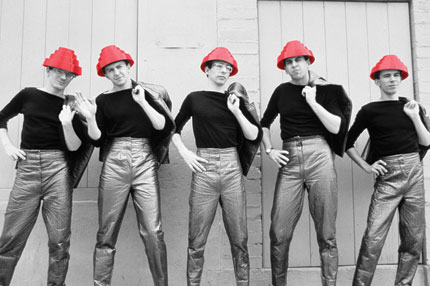
With their third album, 1980’s Freedom of Choice (whose cover introduced their trademark red “Energy Dome” flower-pot hats), the band became huge when a single meant to spoof Dale Carnegie–style positivity inspired an S&M-tinged video.
Mothersbaugh: “We’d talk about movies and all these things we wanted to do, and the record company people would start to trail off and change the subject, like they were thinking, ‘Art band, art band.’ Then, all of a sudden [Warner Bros.], who had ignored us for a couple albums — although we stayed in the black the whole time — looked at us as, ‘Do whatever you want to do, just do another “Whip It.”?’?”
9. LITTLE DRUMMER BOY DISCOVERS CALLING
Josh Freese, who would go on to play with the Vandals, Guns N’ Roses, and Nine Inch Nails, and become a permanent member of Devo in 1995, learned to play drums to Freedom of Choice.
Freese: “It was the first album I got, when I was eight years old. I sat in my basement and played along to it all the time, so it was crazy when we did that tour last year where we played it top to bottom. It’s fun in the way that it’s very metronomic and the patterns are very deliberate and kind of nursery rhyme. A lot of people think that it’s a drum machine on ‘Whip It.’ But that’s Alan Myers.”
10. OH NO, IT’S OH NO, IT’S DEVO
For their fourth album, the band wanted to crack that whip on producer Roy Thomas Baker, then famous for his work with the Cars and Queen.
Mothersbaugh: “He lasted about three weeks before he started showing up very late to the sessions and leaving very early. Producing a record was definitely a culinary experience for him.”
Casale: “He brought one of those expensive wicker English picnic sets to the studio, with plates and silverware, and then he’d bring in a huge deep-dish pizza, and he’d pour a little wine and go, ‘I think it’s time for a little drinky-poo.’ We watched him gain weight as the project went on.” mothers-baugh: “He would time it perfectly, and could finish one slice of his pie for each song.”
Casale: “Baker mixed that stuff and it sounded awful.”
Read the entire list in the August 2010 issue of SPIN, on newsstands now.