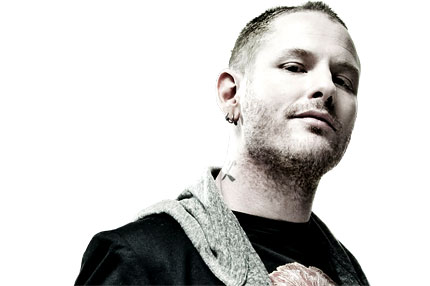
Slipknot frontman Corey “#8” Taylor led the band’s angsty horror-metal to the top of the charts while wearing ghoulish masks and leather S&M gear. But with the future of Slipknot unknown following the death of bassist Paul Gray, Taylor is focusing on his other band, Stone Sour-and he’s doing a lot of growing up.
“I’m 36 now and I can’t sing about teenage angst anymore,” Taylor tells SPIN.com of Stone Sour’s new album, Audio Secrecy. The record, the band’s third, is a mature and intensely personal work for Taylor, who has gone through a divorce, gotten re-married, and lost his friend Gray, all in the past three years.
Taylor, a funny dude who occasionally refers to himself in the third person, chats with SPIN.com about Audio Secrecy, singing Motorhead while wearing Spider-Man pajamas, and treating his family to dinner at the Cheesecake Factory.
Why call your record Audio Secrecy?
I love when a phrase has a few different meanings, and I was trying to find play on words for “idiosyncrasy.” Idiosyncrasies are those little things that differentiate us, that make us individuals. But at the same time they tie us together. I hit on “audio secrecy” and immediately realized that it can mean something completely different to people. It can mean something dark or practical, light or funny. After thinking about it for a while, I realized it’s a descriptive way of talking about music. Consider classic songs like “Master of Puppets” by Metallica or “These Arms of Mine” by Otis Redding. They’re drastically different songs, yet both epic songs. Why do they sound the way they do? Why do people gravitate towards them? To me it’s about the undertones or the overtones, the details-the way it was recorded, the temperature in the room, the instruments they used, the performance, the mixing and the mastering. It all comes down to these little elements. That, to me, is audio secrecy. That’s what makes one song killer and one song filler. What makes one song live forever and the other one delegated to a bargain bin.

I understand Audio Secrecy’s album art is important to you…
We wanted to play with the idea of a secret society, like Skull and Bones or Illuminati, and tie in little clues or secret folds on the cover so it becomes something different all together. The way we looked at it was, “What if this is the last album to ever get released by a band?What would you want to do with it?” Because in this era of zip drives and memory sticks, there’s no guarantee you’ll be able to release another physical album. We really wanted to make a statement with it. I can remember waiting in line to buy Iron Maiden and Metallica tapes and I would study the liner notes. I would read the names of the people they thanked or the little anecdotes and just wonder what they were thinking when they added that. I want to keep that going. I refuse to think that the record industry is dead because I’ve signed enough copies of my albums to know that people still buy them.
When did the new songs come together?
Most started back on the Come Whatever May tour. But some songs go way back. We were originally entertaining the idea of releasing back-to-back albums because Come Whatever May sold so well. But at the time it just made more sense to do record another Slipknot album. So there was still a lot of material that was ready to go. Plus we were writing stuff right up until the moment that we went into the studio.So it’s a combination of the old and the new, and everything blending together really well.
Stone Sour recorded with producer Nick Raskulinecz (Foo Fighters, Deftones). What do you like about working with him?
He’s very much like me; he has a great mind for all kinds of music; he doesn’t just cater to one style or one genre, or one type of production. He loves heavy music, slow music, acoustic music, and driving rock tunes. He just sees the entire spectrum and we try to embrace all those different types; we don’t want to repeat ourselves. Working with him on this album was a no-brainer because we have so much different material and we needed someone who could pull back and look at it as a whole and go, “Okay, we’re going to be able to make an incredible album with this.” And it worked!
NEXT: You recorded the album in Nashville during the floods. What was that like?
It was weird, man. I was actually in Des Moines when the flood hit. I had flown back to hang out with the family for a little bit and I had no idea about the floods. So my wife and I were flying back to Nashville and we had a layover in Memphis, and all these people are talking about the floods. I was like, “What are they talking about?” I immediately ran over to one of the TVs, which run CNN ad naseum, and low and behold there’s the Grand Old Opry under five feet of water. There are all these houses just blown out in water. When we got back to Nashville and were driving to the house, I had to take like four detours; there was water everywhere. It was like driving through a river. Luckily, it flooded around the studio, so we weren’t affected by it. But there were days that I would see people literally in boats, big boats, rowing up to their front door.
You were lucky, a lot of people lost thousands of dollars worth of instruments and masters.
Oh, yeah. There was a warehouse full of instruments that were destroyed-and it didn’t have any insurance. Oh my god, I don’t even want to imagine that. You’re talking about unique, classic, antique instruments. But the bigger picture is that so many people lost their houses, you know? I did a lot of work with the Gibson Foundation. They were taking donations through the National Flood Relief, and I’m till trying to get the word out that people still need help.
With its lyrics about heartbreak and other struggles, Audio Secrecy seems deeply personal.
It’s a very honest album for me. For the longest time I felt compelled to talk about how angry I was about certain things. But I can’t be that guy. It made sense 10 years ago because it still was very fresh. But now I’m singing about the things that I’ve gone through in the last five years-the different relationships I’ve been in, the end of my first marriage, my new marriage. Also, it’s not just romantic relationships, but relationships with friends that I’ve seen change for the worse over the years, and how you try to close that gap but you can’t relate to them anymore. These are people that you grew up with, people that you’ve known half your life, and to see how they’re becoming less and less recognizable. It’s very much about how long it’s taken to wash the dirt off my hands.
Tell me about some songs specifically.
“Hesitate” is one of the best songs I’ve ever written. It’s a true epic that’s beautiful and dense and very melancholy. It’s a song about being set on fire by a huge passion that you don’t know if you can handle. It’s about having the courage to walk away from that situation, and knowing that you’re better off for doing it, that you saved yourself from three years of hell and depression. Sometimes it’s scarier to be alone than to be miserable with someone else.
“Unfinished” is kind of like that, too. It’s a driving rock tune that’s about beating your fist against the wall of someone’s personality and the desire to put a period at the end of that sentence, yet not getting any reciprocity in return. “Let’s Be Honest” is basically about having a little dry sarcasm and owning up to the fact that that a relationship sucks.Can we just agree that it’s not healthy for each other? It’s not going to work. Let’s just call it a day. The song is retracing the past and listing the reasons why.
Tell me about the “Say You’ll Haunt Me” video, which recently debuted online. (Watch here)
It’s a video we shot with [director] Paul Brown (Slipknot, Korn) and tried to tie in the same concepts as the artwork for the album. The concept is that things aren’t necessarily what they seem, and any moment the tide can change. I wanted to make something that people were going to talk about. There are hidden things in the video that are going to lead into the next video, which is probably going to be for “Hesitate.” We’re going to tie a few of these videos together and try to tell a cool story.
I recently saw footage of you performing with Camp Freddy in Las Vegas-wearing Spider-Man pajamas.
[Laughs] Well, I didn’t realize that this show was a pajama party. It was this weird, kind faux-swanky, douchbag DJ party. My wife was going to Target and I told her, “Pick my up some pajamas, I don’t care how ridiculous they are.” She came through a thousand fold. Not only were they Spider-Man pajamas, but they were for 8-10 year olds. I can’t believe they actually fit as well as they did, which kind of scared the crap out of me. But I think I’m the only person in history to sing Motorhead while wearing Spider-Man pajamas. I’m very proud of that.
If Audio Secrecy hits No. 1 how will you celebrate?
I’ll probably take my family out for dinner. That’s how I roll.I recently quit drinking again, just because it kicks the crap out of me. I drink one night and then I’m down for five. It just sucks. I’ll probably take the family out for Cheesecake Factory. That’s one of my favorite places. More and more I really look forward to time with my family. I work so much that that time is really few and far between. I want to make sure I get as much positive time with them as possible.