
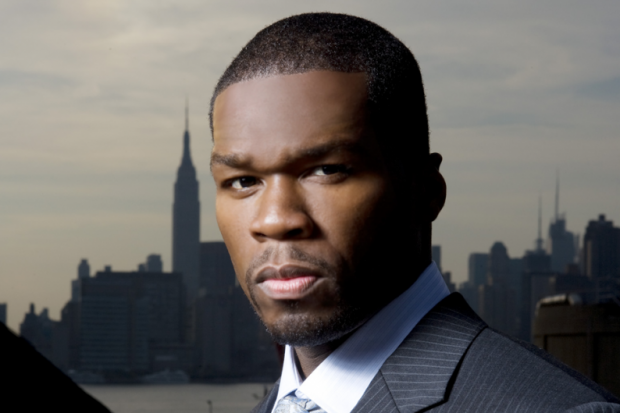
What follows is an unabridged version of the story that appears in our July issue.
For the moment, 50 Cent is preaching to the choir. While a gaggle of assistants and security personnel lounge around a Manhattan recording studio, their multiplatinum benefactor discourses on how violent films like Scarface and GoodFellas have a greater potential negative impact on kids than hip-hop does. “That’s right, uh-huh,” echoes G Unit capo Tony Yayo, like a grumpy, possibly armed Ed McMahon.
Then, suddenly, 50 walks over, puts his face an inch away from mine and says, “Ask me if I’m a role model?”
Are you?

“No, but I’m inspiring to people.” He grins and turns away, inscrutable point apparently made.
With the delayed September release of his third album, Curtis, the rapper born Curtis Jackson on July 6, 1975, in South Jamaica, Queens, is desperately hoping to inspire a downloading public that is purchasing far less music than when he released his first two albums — 2003’s Get Rich or Die Tryin’ and 2005’s The Massacre, which sold almost 20 million copies combined. Curtis’ first two singles (“Straight to the Bank,” “Amusement Park”) have yet to become the soundtrack of the summer. His acting career, though busy of late — the war drama Home of the Brave with Samuel L. Jackson, prison-boxing flick The Dance with Nicolas Cage, and drag-racing vehicle Live Bet — has met with critical yawns. And even though the G Unit empire (a stable of rappers, a clothing line, shoe deal, books, video game, a recently sold stake in VitaminWater) earned $41 million from June 2005 to June 2006, 50 knows that if he wants to remain “rap’s MVP,” as he boasted on the hit single “Hate It or Love It,” he has to stay as edgily focused as ever.
You’re 32 now, and as you get further away from life on the street, does it get harder to reconcile who you are on record with who you are in real life? On the new album, you still rap about cooking crack and shooting people, but you’ve been living in a mansion in Connecticut.
Your experience is your life; the things you go through make you who you are. So I’ve spent four years being what people call “successful,” and all the rest of my life not having it. And maybe because of that, the painful moments are more visible in my memory. If I’m writing about the environment I grew up in, then guns are gonna be goin’ off. Now they haven’t gone off around me in real life as much as they have in my music because I haven’t been able to capture real life perfectly in my music. A lot of my songs are like a record that’s skipping. I’ve been repeating these scenarios until I do them perfectly.
That gunshot sound has been going off on your records since well before Get Rich or Die Tryin’.
That’s what I hear when I think of where I grew up. And it also comes from the experience of me being shot. It’s weird — people associate me with gun violence, when I was the one who got shot. I haven’t ever shot anybody.
But everybody thinks you have.
Why?
Well, you’ve said so in interviews, both directly and indirectly, and you rap about it all the time.
That’s an assumption; there’s no proof I’ve ever shot anybody. What I think scares people about me is that I was shot nine times, and I’m okay with that. I accepted it and moved on, and it didn’t slow me down. Being shot wasn’t the most painful experience for me, anyway. The most painful experience was not knowing what I was going to do with my life after my record company didn’t accept my phone calls anymore [Columbia dropped 50 in 1999 after the shooting].
That must have been devastating. You made this amazing record [Power of a Dollar] and you’re excited to put it out, and then you’re in the hospital and the album’s shelved.
It was terrible. I was mad. I was scared.
And since you were shot in the mouth, you didn’t know if you were gonna be able to rap again.
My voice was completely different. I had my teeth knocked out of the whole side of my mouth, and my tongue got bullet fragments in it. But it’s funny — this is the voice that everyone enjoys now. It’s made me think that maybe it was God’s plan, maybe I was supposed to be shot, because after that, I signed a publishing deal [with EMI] on my hospital bed. They gave me a $100,000 advance. But then they dropped me because they didn’t realize I’d been shot in the face and might not physically be able to perform. They used it as a tax write-off, but I lived off that $100,000 during the time period when I was hurt and couldn’t do music and provide for myself.
Did you have to completely rethink the way you rapped because of the injury? Before, your voice had more eagerness and intensity to it.
Everything changed. My mind frame changed. When all those things happened, the fun went out of my music.
When you recorded the songs for Power of a Dollar, were you convinced you were going to make it big?
I felt like I was ready in 1997 when I was writing music with Jam Master Jay. But I was so far from being ready. In ’99, I put out “How to Rob” [the barbed single in which 50 threatens to clean out “industry niggas,” from Diddy to DMX to Wu-Tang to Timbaland) because Columbia wasn’t understanding what I was trying to do creatively, and it just took off. It was almost taboo to mention names on a record after Tupac and Biggie got shot; nobody wanted that type of friction.
It was controversial, but it was also funny. Rappers aren’t known for having a good sense of humor about themselves, though. What did you expect would happen?
I knew people would misinterpret it, and they did. But for me, there was no Plan B. I absolutely had to be a success in music. The only thing positive in my life was music, so I said what I needed to say. I mean, the lyric on the record is: “This ain’t serious / Being broke will make you delirious.” So if somebody wants to take it seriously, then they just want to misinterpret it, or they’re just really fuckin’ stupid.
There were several times on Power of a Dollar when you stepped back and said that you weren’t serious.
I don’t do that anymore because the intention has changed. When I was in the early phase of my career, I was at a desperate point. My entire company had no idea who I was, and that was me trying to make them understand, but they just didn’t get it. But what they provided for me was a functioning record company that I could learn from. I’d get up every morning and go to Columbia like I had to go to work. I’d go see my product manager and learn what his responsibilities were. I’d go hang out in the street department and see how they did mix-show radio, and then learn the responsibilities of the A&R [team]. I’d be up with the art director, watching what he did. I was the intern who couldn’t get sent to the store for coffee. [Laughs] They gave me the information that was necessary for me to know what to do when they dropped me.
You’ve said that the new album, Curtis, is partly about you going back and exploring how you felt before you were even known as 50 Cent, when you were a little kid.
I wrote and recorded lyrics for this album at my grandmother’s house again. I went back in the basement, where you have to bend down the ceiling is so low, where I wrote Get Rich or Die Tryin’. Being in that environment helped me remember things. I had to dig deeper. I’m not actually in that lifestyle; it’s not surrounding me as much as it did prior to Get Rich.
What is it about that time that you are trying to capture?
Those points where I was more vulnerable. After I’ve been a success, there hasn’t been that much vulnerability for me.
What kinds of vulnerabilities?
Well, when I was younger, I experienced being beaten up. You know, that’s actually what brings out the aggression I have now. When I was ten years old, my mom had already passed, and I’d get into physical altercations. I’d get jumped. To me, after my mom passed, everything, literally, that went wrong, went wrong because she wasn’t there. If I wanted to go to the park, and it would start drizzling, it was happening because my mom wasn’t there — because everything good came from her.
But she was a drug dealer?
Like I say on the record, “My mom told her baby boy the Lord was gonna bless us / Then dope bought us the shit that food stamps wouldn’t get us / And they don’t understand we were just trying to make it / But where I’m from when you want shit you gotta take it.” Only a child would think that the Lord’s blessing would be dope. The innocence of that line is the significance in it. My mom hustled, so everything I experienced having that was nice came from her making that decision. She didn’t she see welfare or Burger King as a real option. She did what she thought she had to do to take care of me.
You haven’t ever really written about your own family — your son, Marquise, or his mother.
You know why I wouldn’t do it? Because it would be hard for me to make reference to her without being disrespectful. [50 has been feuding in court over child support with Marquise’s mom, Shaniqua Tompkins.] Say, if my mom was using drugs, I would probably lose respect for her. But if someone else was disrespectful to her, I would respond immediately. And my son has so many of my qualities that I feel like he would feel the same way, even if it was his father saying it. He would find some resentment toward me for saying something bad about his mother, so I don’t talk about it.
That’s much different than how Eminem has handled it.
I got no comment on that. But also, my son’s mom had a daughter before me, and I’ve never really talked about her because I wanted to allow her to have a relationship with her dad. She’s gone down South to see her father on vacation in the summer, and I’ll call and ask her if she’s having fun, and she’ll say, “No, not really.” And I’ll say, “Why?” and she’ll say, “Because he’s cheap.” And that really bothered me because he’s not cheap; he’s not cheap at all. He just doesn’t have what I have. And that’s, like, damn, I can remember being where he is.
It seems like there’s more difference between Curtis Jackson and 50 Cent than you let on.
50 Cent is the aggressive portion of Curtis, and because of the musical content, there’s a perception that I’m darker than I am. That’s why I enjoy film projects, because they allow me to show emotions that I don’t normally show through my music. Hip-hop is such a competitive art form, so anything you put out that makes you vulnerable, puts you in danger, because other people are gonna use those statements and things against you, to discredit you later.
How does it feel to release your record in this post–Don Imus, anti-rap environment where the content is under such scrutiny, and you’re basically the poster boy for negative images in hip-hop?
None of this is about hip-hop. The whole thing’s racial, and I mean that. When a white talk-show host made a comment, and black leaders spoke out and said he couldn’t say that, the white folks got angry, so they pointed at hip-hop. Think about this. What about our First Amendment rights? What about the fact that our country’s at war? We got way bigger issues out here. There’s one of the president’s top guys who resigned for using a dating service [Deputy Secretary of State Randall Tobias], but it’s not okay to say ‘ho’? That’s who he’s hanging out with! Hos!
Then are these black leaders, like Al Sharpton and Jesse Jackson and Benjamin Chavis and Russell Simmons, who are saying hip-hop should be cleaned up, just hypocrites who are looking for easy publicity?
They don’t mind the cable television programs giving you the same content; they don’t mind the Internet having the same content available. I think it affects people a lot more to see a film where somebody realistically gets their head blown off than to listen to somebody rapping for three minutes. And what about rock’n’roll? The guy who shot up Virginia Tech was a Led Zeppelin and Nirvana fan. If he’d had a 50 Cent CD in his case, we probably wouldn’t even be talking right now.
Don’t you think hip-hop’s a target because people think kids look at it as more real than movies, because the artists are seen as living the lifestyle they rap about?
No. No. The kids know the difference between entertainment and reality. If not, something’s the matter with the kid. If a person is so out of whack that they allow music to influence them to do something violent, then they can be influenced by anybody they have a conversation with on the street.
But so many kids are in broken families these days, and they don’t have parental supervision, and it’s more of an at-risk situation.
So let’s take the content off cable too, OK? We can sit here and talk about this until you’re writing a book about it instead of a magazine article, because there is no logical way that you can make this make sense to me. How does a song that’s three minutes long have a stronger impression than a film with two hours of violence? What is 300 about? It’s graphic violence, computerized warriors killing each other, and it’s huge entertainment. But with hip-hop, because it’s racial, they’ll try to find anything on any level, and point at a person and say, “That’s not right,” especially if it’s one individual, one artist, hoping that that person makes a foolish response that puts him in a space where they can make an example of him.
Like Cam’ron saying on 60 Minutes that he wouldn’t snitch on a serial killer if he lived next door.
Yeah, he was just stupid. They set him up and he fell for it.
I think a lot of these morality police types just want you to sit down and agree that the violent or sexist content on your records is potentially damaging to children, and that you’re open to possibly adjusting your lyrics.
Why?
Because those images play into negative black stereotypes and it’s time for rappers to take more responsibility.
Well, isn’t it negative to show that stuff everywhere?
Yeah, but what about you?
I ain’t gonna say that. I’ll never say that. People want all kinds of things, but that doesn’t have anything to do with me. That’s based on what they want. You can’t just submit to everybody’s wants, and then expect people to respect you. If you do that, then what do you have left that’s special about you?
He pauses for a second. Sitting on a sofa across from me, he looks to the side, then excitedly inches up closer, clasps his fingers together almost formally, and smirks.
Look, let’s talk about Scarface [the 1983 cocaine odyssey written by Oliver Stone and directed by Brian DePalma]. OK? And how it impacted people. It was more than just violence in a film. It gave you a description of somebody coming from not having anything, to selling drugs to the point where they made it beyond the expectations of anybody who actually sells drugs in the neighborhood. It showed us that. And Godfather, Goodfellas, those were movies that made an impression. If you made a study of people who are incarcerated and asked them if they have those films on rotation, I have no doubt they would tell you, yes, they watch those films, repeatedly. Did that condition them mentally to go out and do what they did?
No, but all those films ended very badly, and you can say that there was a moral of sorts involved because the heroes all died or were ruined.
And you know what people are gonna say? “I’m gonna do exactly what he did, I’m just not gonna go out like he did!” The statistics tell you that [if you’re selling drugs] your ass is going to jail or you’re dying, one or the other. It’s obvious. And people know that, and they still go into that life. They tell themselves that they’re going to get out before something bad happens. It doesn’t matter what movie they’re watching or what song they’re listening to. You can’t use entertainment as an excuse. I wanna show you something, come here for a second.
He gets up and asks me to follow him out of the recording studio and down the hallway. We enter a room where members of the G-Unit entourage are congregated. HBO is blaring from a wide-screen TV. A scowling Tony Yayo sits at a table to the right, his back against the wall, as he methodically constructs an enormous blunt. 50 Cent addresses the group.
Yo, let me ask you a question. People who have been incarcerated, for whatever reason, around us in the hood, how often do they watch movies like Menace to Society, Goodfellas, Casino, Scarface?
The entourage immediately barks answers: “All of them, all the time.” “Repeatedly, repeatedly.” “People watch Scarface 100 times a year, B.” “Over and over and over.”
Why do you think they watch ’em? I think it helps give them the aggression necessary to move around in their actual neighborhoods where all this shit is going on. They got the tape at home and they’re watching it over and over, and they come outside with a different swagger. A movie is two hours of glorifying the lifestyle, but you’re gonna talk about a song that’s three minutes long? What about DVDs like King of Cocaine, about Pablo Escobar, that gives them the fuckin’ information! BET won’t play graphic images of the music, but they’ll show you The Wire, and The Wire is giving you a vivid description of what the lifestyle is like. And American Gangster is showing you each one of the individuals and how they did it. It makes them legends much more than a song. You got Tookie [Williams], I don’t know him, I’m not a Crip, I’m not from Los Angeles, but I’m more aware of him now after seeing American Gangster and seeing the information on him. It’s like, wow, now I’m familiar with him. But they’ll pardon Charles Manson and not Tookie Williams. You can find things wrong with the world and we can talk about it all day.
“That’s right, uh-huh, yeah,” says Yayo, licking the blunt. The peanut gallery chimes in, “Yeah, yeah, yeah.”
What about the MCs — Chamillionaire, Ghostface Killah, Master P — who have said that they’re not going to curse in their music anymore, in response to the post-Imus outcry?
None of those people sell records.
Chamillionaire sold more than a million records.
Let him go sell gospel records, if he’s so fuckin’ righteous. I can write around the curses if I want to, but you can’t tell me to write around the curses. First of all, there’s a clean version of the record available, anyway, if people don’t want to hear that content. This is adult entertainment. Why is pornography legal? Wouldn’t you say that the women who do pornography are hos? They get paid $1,000 to fuck on tape. You understand? And we can’t say ‘ho’? And who’s the leading consumer for pussy on a tape? Middle-aged white men.
The peanut gallery: “White men, yeah. They buy all of it. They’re spending way more.”
These white men are buying the pussy from the hos because they aren’t being sexually fulfilled by the women they have in their traditional lifestyle at home. And they go outside for the thrills without any attachment, so when they go home, there’s no phone number or nobody calling who can ruin their fuckin’ lives. So it’s understandable why pornography is the way it is. But after all that, why is somebody worried about me saying ‘ho’? I make up different terminology all the time. I made an effort to make a reference to a male organ without being disrespectful in a woman’s presence on “Candy Shop.” If you say “penis, cock, dick,” whatever way you want to say it, that’s going to be disrespectful in the presence of some women, so I said, “the magic stick” and “the candy shop” is the bedroom and the “amusement park” is the bedroom, trying to come up with a way to do it where you’re not being disrespectful. But those efforts apparently don’t mean very much.
So what do you really think about those guys who say they’re not going to curse anymore?
They’re just saying it. They’re not going to really do it.
Yeah, it’s hard to imagine Ghostface is going to stop cursing, especially considering his last couple of records.
The peanut gallery: “Nobody even cares what he does.” “Who’s listening to him, anyway?” “That was the ’90s, B. Kids don’t even know Ghostface anymore.” “The streets are different now,” says Yayo. “Guys like Ghostface don’t matter. They don’t. They had a run, but it’s over.”
But can’t he just make a great record, even if it doesn’t sell, and we can appreciate it as listeners, as hip-hop fans?
No, because a great record is embraced and enjoyed by the public. And it’s played in cars and clubs.
What if it sells a couple hundred thousand copies, isn’t that valid? Or does it have to sell millions for you to take it seriously?
In my camp, a couple hundred thousand records is a failure. From my perspective, if I sell 200,000 copies, after selling 12 million records, it’s considered terrible.
But maybe he’s trying to make a different kind of record?
What, the kind people don’t buy?
No, one with incredible, detailed storytelling that’s moving and powerful, and isn’t dependent on some obvious hook.
Look, I understand all that. But if you’re on a major record label, and he [Ghostface] is, and you sell a couple hundred thousand records, that was a failure. Your fuckin’ photos and videos aren’t recouped with 200,000 copies sold.
OK, but can you at least acknowledge that a commercial flop, like, say, [Ghostface’s] Supreme Clientele, can still be an artistic achievement?
“He didn’t even write that album, man,” says Yayo, his eyes narrowing.
What?
Yayo: “He didn’t write it. That kid from Far Rockaway — Superb — he wrote that record. You know Superb from Far Rock?”
No, and that’s a pretty serious charge.
[50 quickly jumps back in] I don’t know nothing about any of that. He’s the writer. I’m not gonna say he ain’t write it. But it still didn’t work! I mean, when I make music, I make it with the intention that the world’s gonna enjoy it. I have music that I feel like is really good music, but I haven’t released it. There’s things playing at my house right now that’s never gonna be played on the radio. And that music isn’t out there, because I didn’t feel like enough people would actually respond to it. Like, if I said, “Hey, this album is for me, that’s why I named it Curtis, and if they don’t pick it up, hey, they don’t pick it up. This is just something I wanted for myself from an artistic standpoint.” If I took that position, it’s a cop-out. You make music with the intention for the masses to enjoy it. If not, then you should take your CD and play it only in your Walkman. It’s crazy to think that you’re going to make a record and put it out commercially for the world to listen to and then say you made it for yourself. And I’ve heard it countless amounts of times from artists in different periods. They’re like, “I don’t really care about the sales, this is about the art form.”
Peanut gallery: “That’s bullshit, man.” [Laughs] “That’s bullshit. That’s what you say when you know nobody gives shit about you.”
That’s an artist who’s so artistic he should just have a smock and be painting pictures for himself instead of trying to sell people music. We’re in the music business. When they forget that last half, that’s where it gets messed up. In the music business, you do what makes sense for music and business. So if the artist makes a record they know ain’t gonna sell, then why do they allow the company to spend money marketing it? They’re just making the wrong music at that point — creatively. Sometimes, they just get out into a different space where they don’t know what to write. I’ve been around rappers, what was the freestyle guy, Supernatural? He was incredible, he could rap about anything, about Mars and cars, whatever, and Craig G was like that. But they didn’t have a specific thing that they were basing their music on that people could embrace. My music is based on my actual life. You might be a rapper that could beat me at something, but you can’t beat me at being me, and this is what the world’s embraced at this point.
Peanut gallery: “That’s right. Uh-huh.”
You got people who are inspired by the music. They see it and they see where it comes from. You see this [holds up a platinum, bling-encrusted cross]? I don’t wear this all the time. But when I go out in the street, I put it on. You know why? Because these kids, I’ll blow their high if they see me without it. And they sure don’t wanna fuckin’ be you if you don’t have the stuff that excited them about you in the first place.
So should kids look up to you?
If they’re inspired by me. People who come from where I come from, I give them hope. I make them believe that what they want to achieve is actually possible. If they see me going from a space where I didn’t have anything to a space where I have everything, they’re inspired. But you can’t tell people they should do what you’ve done, because everybody’s made big mistakes. It’s like, publicly, all the things I say are good, if you watch what I do. What I say on record is entertainment; but what I’m actually doing with my life and the things I’ve had the opportunity to do is what makes me inspiring.
Would you ever make a record just for yourself, and put it up for free online, just as an artistic statement.
Any artist who tells you they made the record for themselves is just saying that ahead of time because they’re afraid nobody’s going to embrace it. They say, “I’m just doing this for me, this is real hip-hop right here.” Come on, man, nobody cares about that shit, they want good music. If it ain’t hot, it ain’t hot.
So it’s not helping the art form if it’s not “hot.”
You’re actually hurting the art form, if your music isn’t urgent enough to drive people to buy it, you’re hurting the art form. You’re just another shitty release on the schedule.
You responded to Oprah’s criticism of hip-hop by saying that she was black on the outside but white on the inside.
Oprah is a good businessperson, right, considering that she’s a billionaire? And her job is to go out and cater to as many middle-aged white people as possible.
You definitely think that’s her goal?
She doesn’t ever say anything that anybody from the ghetto is gonna ID with. Take a poll. Find me some young black women who ID with Oprah.
I’m sure I could find a lot.
I’m sure you can’t. I guarantee you will find a way bigger demographic of middle-aged white women than young black women. Her issues are aimed at them. She can escape the fact that she’s black because she’s a billionaire, and the white women think, “Hey, me and Oprah, we think the same thing,” so they tune in and enjoy it and watch the show.
But isn’t the majority of your audience white kids? Aren’t you thinking about them when you’re making a record?
No, what I’m doing is writing music from my perspective on my experience and the harsh realities, and other people relate to it. And how would I do that anyway? Where’s the research that would tell me what to say? Give me that, make me feel like I’m a genius; that I sat there and said, “This is what the young white men and women of America are really going to enjoy,” and then I went and made Get Rich or Die Tryin’.
Are you worried about the state of the music industry and that hip-hop record sales are down 30 percent from the time of your last record?
You know what’s interesting to me? If we’re selling 30 percent less records, then really, what’s the problem that people have with us? Why isn’t the violence down? If we’re that fuckin’ influential, you know what I’m sayin’?
Violence should be down 30 percent?
Yeah, why isn’t the violence down 30 percent? Ask that question in your article. I’d like to know the answer to that!