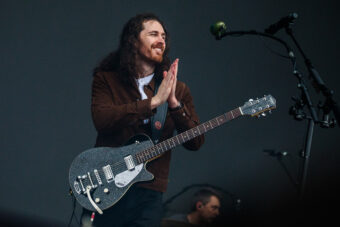
Friday Five: The Gipper Gets Got by Killer Mike, and One Funky-Ass James Brown Book

in_array was not an array object

by Brandon Soderberg

I've been meaning to talk about RJ Smith's The One: The Life and Music Of James Brown for a few months now. I guess it's a biography of James Brown, though it's more like a very long essay about J.B. that moves through his life chronologically but doesn't feel the need to touch on every moment, assumes that you know some things about the legend, and will jump into these poignant asides about, like, shamans, and the wrestler Gorgeous George, or give you a quick history of the Cracker political party, and then dive right back into the R&B/soul/funk icon's life. I want to call it a "post-biography," but that's the worst thing I've ever typed. Have you, by any chance, read David Thomson's The Whole Equation: A History of Hollywood? It has that same kind of discursive approach where hard "facts" are important, but no more important than opinions and super interesting digressions.

Smith is particularly delicate about handling Brown's politics: A sloppy, though not exactly contradictory, mix of rugged individualism, '60s liberalism, and cutthroat looking-out-for-number-one egomania. Probably common knowledge to plenty of you reading out there, but I wasn't aware of some of Brown's business ventures until I read the book. He founded a fast-food franchise called James Brown's Gold Platter with the idea to encourage black business owners and to provide young African-Americans with the chance to move up. He also created a James Brown food stamp/coupon in the Los Angeles area, which was given out in stores run by African-Americans, further encouraging support for black-owned businesses. The state of California quickly put a stop to that idea, though.

I think there are a lot of connections between the talk you hear from so many rappers-turned-businessmen and Brown's attempts to merge self-sustaining capitalist ventures with pull-up-the-people business plans. Whether Brown's failed fast-food gambit proves that Jay-Z is a noble entrepreneur or just making himself feel better about his millions is for each of us to decide, but it's worth noting that the values espoused on Watch the Throne aren't new to black superstardom. Because it isn't tethered by typical music-bio expectations, The One really encourages this kind of thought riffing. I highly recommend it.

50 Cent feat. Kidd Kidd "O.J."
If you have a small child, or if you're a 27 year-old rap blogger who likes to get high and play video games designed for babies, then you might recognize the sample on this Mike Will Made It production. It's composer Tomoya Tomita's title screen theme to Kirby's Epic Yarn, for the Nintendo Wii. At least I think it is? Like, 75 percent sure. Mr. Will Made It didn't answer my tweet, but he has been known to swipe a sound or two from a video game (Gucci Mane's Tetris-sampling "Get It Back"). On The Lost Tape, which is supposed to be 50 Cent's return to mixtape prominence, he either raps his ass off or gets goofy. On "O.J.," he just does the latter, thanks to a hook that's in poor taste, like something off 50 Cent Is the Future: "Put on my O.J. gloves and watch me kill this shit…I'm pullin' off an O.J., I'm killin' these bitches!" And new buddy Kidd Kidd, whoever that is, has some LOLZ-worthy, damn-near-dada non sequiturs here: "Tell the pigs to kiss my shitter / Yeah, I'm kind of thinner, but goddamn your jeans are slimmer / I don't want you 'round my child, you look like a sex offender." The whole thing is ridiculous. 2012 finally has its "Zan with That Lean."

Camp Lo "52 Pick-Up"
Another version of Fort Apache was released back in 2006. There's probably some mildly interesting reason why that version has been erased from the Internet and replaced with this "mixtape album" that's barely even an EP. The DD172 logo on the back cover has got me thinking I should chalk this one up as more Dame Dash fuckery in the style of the half-assed hard-drive purge that was Curren$y and Ski Beatz' Muscle Car Chronicles. Then again, isn't it kind of perfect for a group as mired in nostalgia as Camp Lo to resurrect their half-a-decade-old scraps? Are they the original hypnagogic poppers? Is there a group before them so thoroughly interested in evoking the feeling of their childhood years? 1996's Uptown Saturday Night was rakish street rap by way of blaxploitation soundtracks damaged by the hiss and pop of a cheap 16mm print. "52 Pick-Up" shares its name with the John Frankenheimer flick from the '80s that was trying to be a '70s flick, and Ski Beatz' beat kicks and claps like a lost Def Jam 12-inch — or a track from the second half of Clipse's Hell Hath No Fury. You decide. Man, we're just in a maze of misremembering here, aren't we?

G-Mane feat. ST 2 Lettaz "Money Machine"
The honeyed beat from Dave Luxe with G-Side's ST doing his best Max Julien impression and shouting-out 8Ball & MJG's "Break-A-Bitch College" should give you enough of a warning: This song is the latest in a long line of stone-cold, smoothed-out, pimp-talk rhymes. But nothing's ever that simple for Florence, Alabama's G-Mane, a sort of Bun B and Nate Dogg and Ice Cube all rolled into one (he's really a contemporary of all three, yet a nostalgia act if only for the reason that he refuses to adjust his style and knows how the Internet works). And so, right in the middle of "Money Machine" is Arthur Jensen's classic monologue from Network ("You are an old man who thinks in nations and peoples..."), halting the blazed-on-the-highway swerve, reminding you that our lives are dominated by evil corporations, and tying entry-level pimpin' to a world out of control with exploitation and abuse. ST goes in on this one, but it's G-Mane's laconic wisdom that keeps the song from being just one more pimp-slap rap: "I'm what they fear, America's nightmare / Black and educated with a little money to spare / Yeah, I know they don't like it, but I don't care / They can kiss my Gucci underwear."

Killer Mike "Reagan"
The best noises on R.A.P. Music aren't those cyborg cur- stomp drums or the dystopian synths. It's the juicy, comedic keyboard gurgles sloshing away in the background. They don't connote anger, but disgust, which is a far more appropriate response to what's detailed on "Reagan." As was the case with Ab-Soul's "Terrorist Threats" last week, I find the "Obama is exactly the same as all the rest of them" rhetoric pretty lazy and cynical. This song is far more effective when it's turning Reagan into the symbol and not just a symbol for political corruption. But I get the sense that if I told Mike any of this, he'd remind me that Robert Gates, number two in the C.I.A. during the Iran-Contra Scandal, is Obama's Secretary of Defense, so I should probably just STFU. More compelling than a Wikipedia entry and as insightful as the anti-Reagan chapters of Rachel Maddow's pop-thesis Drift, "Reagan" feels like a necessary intro to Iran-Contra and the alleged "dark alliance" that connects the C.I.A. to crack sales. Killer Mike should be a guest on Maddow's show, don't you think? I need to start a "KILLER MIKE ON MADDOW" Facebook group.

Struggle feat. Yelawolf & Ounze Zilla "Satellites"
Look, I didn't expect Yelawolf's half-great, half-terrible Radioactive to move through the major-label system unscathed, but I was hoping that if it was going to pander, it would've been as this atrociously awesome, double-time rhyming, hard-rockin', tweaked-up, twangy, brostep explosion. There's a whole bunch of sad, weird, poor-ass white kids just dying for that shit! Plus, Yela's touched on country-fried dubstep before ("Growin' Up in the Gutter," "Animal," Trunk Muzik: 0-60's "Billy Crystal") and it's just a perfect fit. Had Yela gone full-on in that direction, it probably would've sounded a bit like "Satellite," from Waylon Jennings' grandson Struggle (maybe you remember last year's "Outlaw Shit"). At some point, it probably would've seemed "problematic" for there to be this narrowcasted white-trash rap scene, but now it feels necessary. There's a white middle-schooler somewhere getting made fun of because his shoes are from Payless who straight up needs a groaning post-Nickelback hook morphing into a sub-Skrillex getupgetupgetup to get through his day, you feel me?

COMMENTS

Evaluating Summer 2012's Big Sequels: What's Worth Seeing?

in_array was not an array object

by Eric Alt

Every year around this time you start to hear critics and bloggers complaining about the surfeit of Hollywood sequels and the industry's overall lack of originality. (This is probably the seventh consecutive Year of the Sequel.) But it's time to simply accept their inevitability and recognize the standouts while avoiding the failures. We took a look at the second (and third and fourth) installments scheduled for release this summer in an attempt to predict their worthiness. Then again, the theaters are air-conditioned, so you'll probably want to make up your own mind.

MEN IN BLACK 3, (May 25)
True sequel or disguised remake? The former. Will Smith and Tommy Lee Jones are back. They even started production without a completed script, which is perfectly in line with the "well, why not?" mentality most franchises hit once they get to a third installment.
Raised stakes? It's difficult to say, since the first Men in Black featured aliens who are out to eradicate mankind. Then the second one featured aliens — who are out to eradicate mankind. And the third one? The aliens are out to eradicate Jones' Agent K (but we're guessing also mankind). The concept of going back in time to the '60s and seeing a young K (Josh Brolin doing his best Tommy Lee Jones) might help broaden the character a bit, but this is a role defined by taciturn unflappability, so where else is there to go?
Hit or miss? Miss. The early trailers are a whole lot of "seen this before," and no movie that has begun without a third act written has ever been any good. Like, say, Men in Black 2.

THE AMAZING SPIDER-MAN, (July 3)
True sequel or disguised remake? Technically neither, but the latter sounds kinda right. This is a complete reboot, but Sony knows that we're only seven years removed from the Sam Raimi/Tobey Maguire Spider-Man movies, so they're banking on familiarity, but also wanting to distance itself from the original three films (this one is touted as "the untold story") and start fresh with new stars (Andrew Garfield and Emma Stone). Why? Because if Sony didn't use their Spider-Man movie rights, they would have reverted back to Marvel, and then Spider-man would be free to join the Avengers AND THAT WOULD BE AWFUL, RIGHT?
Raised stakes? The trailers hint at a mystery involving Peter Parker's dead parents, who are barely mentioned in passing in the original movies, and a connection between them and the new villain (Rhys Ifans' Dr. Curt "The Lizard" Connors). It does seem to indicate a slightly more personal story and not just, "I'm fighting my best friend's crazy dad." Getting into the whole "Who were Peter Parker's parents?" thing adds some dimension to the character. And it looks as though Garfield and director Marc Webb are going to have a little more fun with Spider-Man as a character. Comic book fans know that when Peter puts on the mask, he transforms into a motor-mouthed gadfly who has a one-liner for every moment, to the point where it annoys other heroes. Maguire and Raimi didn't really show that side of the wall-crawler, so expect a funnier (if a little dick-ish) Spider-Man this time.
Hit or miss? It's a tough call. The first reaction is, "Of course, it's Spider-Man," but it is going to be tough to shake the "we've seen this" impression. But it IS the first Spider-Man movie in 3D, so there's that.

THE DARK KNIGHT RISES, (July 20)
True sequel or disguised remake? Sure, The Dark Knight's billion-dollar box office haul guaranteed another installment, with or without the original crew’s involvement, but director Christopher Nolan has clearly been building towards something beyond "Insert new villain. Rinse. Repeat." And everyone else in the cast is back on board. So this is a true sequel, and a franchise rarity.
Raised stakes? Absolutely. In Dark Knight, Batman faced a villain who wanted nothing more than anarchy. Now, with Tom Hardy's Bane, he faces a foe that is his physical match (or superior — have you seen what a beast Hardy is?) and his intellectual equal, and also has a very clear and direct purpose. He wants to topple Gotham's elite, which leads him to possibly uncovering the city's wealthiest businessman's unique moonlighting gig. Nolan clearly has a plan. The original movie was about Bruce Wayne discovering his calling. The second saw him sacrificing his heroic image for the greater good. This time? He may have to literally die for Gotham's sins. That's a pretty impressive arc — if it's true, of course. Nolan has indicated that he sees these films as a self-contained trilogy with a definitive end, but we won't know until we see it.
Hit or miss? You know the answer to that.

THE BOURNE LEGACY, (August 3)
True sequel or disguised remake? Definitely in "disguised remake" territory. Universal desperately wanted Matt Damon to return as the amnesiac spy for a fourth outing (totally ignoring how neatly Bourne Ultimatum wrapped things up), and came close to closing the deal. When it fell apart, they charged ahead with the notion that the movie will instead focus on a totally separate globe-hopping assassin played by Jeremy Renner.
Raised stakes? The trailer contains the giggle-worthy line “He's Treadstone without the inconsistencies” (read: "He's Jason Bourne, ONLY BETTER!"), so the fact that Renner's character can, presumably, remember his home phone number sorta makes him a little more formidable than the hero who was always running to catch up. We guess.
Hit or miss? It will probably be a fun ride, but the Bourne connection may prove tenuous and ultimately unnecessary. And the trilogy was just so tight that it may be hard to get audiences to care about a whole new character.

THE EXPENDABLES 2, (August 17)
True sequel or disguised remake? Just as the original was a throwback to the steroidal action films of the '80s, so part two obeys the '80s action sequel prime directive and simply throws more gasoline on the fire.
Raised stakes? Not particularly, no. The objective isn't the point, is it? These guys have names like Toll Road and Yin Yang and Tool. You're liable to step in deeper soda puddles on your way into the theater. All they need is a target. Another bad guy, another army of faceless grunts. Let's do this.
Hit or miss? It'll deliver what it promises: carnage and quip. But it won't win over anyone who didn't like or didn't bother to see the first one.

Control Voltage's Friday Five: The Summer's No. 1 Jam, 'Fiorucci Made Me Hardcore,' and More

in_array was not an array object

by Philip Sherburne

While Pitchfork founder Ryan Schreiber is handing out a Best New Music badge to dance-pop superstar Avicii — prompting speculation that May 24 is the new April 1, and triggering, in the process, a minor meltdown on the site's Facebook page — I'm dedicating today's column to the underground, with left-field selections from Detroit's Andrés, Border Community hypno-techno wizard Nathan Fake, the Swedish outfit WRD, and the mysterious Dublin producer known as B.D.I. Plus, for good measure, the soundtrack to Mark Leckey's mind-bending 1999 film Fiorucci Made Me Hardcore, which says more about the spirit of rave in a single looped frame than Avicii could manage with an entire battery of crystal-faceted rave stabs.

That's not just for the sake of being "underground," mind you. Some of this stuff might be a little too esoteric to ever cross over, but Andrés' "New For U" is as universal as house music gets. Consider it a No. 1 hit from an alternate dimension, where instead of having gone all Pete Tong, things have gone all Electrifying Mojo. We can dream.

Andrés, "New For U" (La Vida)
Say it with me, now: "Track of the summer." It's not exactly new: The record came out in February, and when Resident Advisor's Andrew Ryce reviewed it last month, he noted that it was already "slightly inescapable." I haven't been going out enough lately to confirm or deny that, but the fact that it's still No. 3 on Juno's top sellers list says something about its popularity — not to mention those 48,000 YouTube views.

In any case, as far as I'm concerned, bring it on. "New For U" is the first release on the Detroit producer Andrés' new label La Vida, after 15 years of records for Moodymann's Mahogani Music and KDJ imprints; for classic, emotive, sample-heavy house, it doesn't get better than this. I'm reminded of tracks like Pépé Bradock's "Deep Burnt" and Black Science Orchestra's "New Jersey Deep"; "New For U" has a similar way of yoking together disco breaks, luminous keys, and T.S.O.P.-style strings. Like a lot of my favorite music, it's full of contradictions: The structure is tracky as anything, but it still feels like a song; it's unusually fast for such doe-eyed deep house, and even rougher around the edges. The high end bristles with static, and the looped break rushes the beat just enough to thumb its nose at lazy DJs. The whole thing is lush and hardscrabble, all at once. The rest of the record's no slouch, either. "Drama Around the Corner" translates doo-wop samples into half-stepping house in a way that reminds me of the Studio Barnhus label; "Jazz Dance," with its walking bass, Rhodes soloing, and splashes of Hammond, is an anthem disguised as a DJ tool.

The vinyl-only release was hard to find for awhile, but it's apparently been re-pressed, as copies are available from all the usual outlets. Get it while you can.

B.D.I. Presents Compassion Crew, "Paper Tears" (Running Back)
For years now, I've been looking for this record. It's from the early 1980s, I would guess, with a grainy black-and-white cover suggestive of the Factory label; the music is a combination of coldwave synths, broken-down drum machines, and tribal percussion and chants, halfway between Antwerp and Africa, like Raf Simons decked out in kente cloth or Bauhaus (the movement or the band) gone tropical. Here's the thing: The record doesn't actually exist, or at least I don't think it does. It's just something I dreamed up, the hypothetical Holy Grail whenever I'm digging through used vinyl. Which makes it all the more impressive that an artist named B.D.I. (or, alternately, B.D.I. Presents Compassion Crew) seems to have reached into the imaginary flea market of my mind and produced exactly the platter I was looking for. A couple of times now, in fact. Last year's "Decoded Message of Life & Love" (Rush Hour) was a masterpiece of humid, industrial funk, steamy as an equatorial factory floor and twice as sooty. Now, for Gerd Janson's Running Back label, he turns back towards the light with "Paper Tears." Imagine, if you will, a more pastel-colored version of the Blackest Ever Black label's Raime. Like them, B.D.I. also seems to be sampling most of his spindly rhythms from scratchy old post-punk records, but he balances out the goth undertones with bright keyboards in a way that suggests he's as much a fan of the Glove's Blue Sunshine as he is Crispy Ambulance. Two alternate versions, the "Tribal Tears Dub" and "Same Victories, Same Mistakes" remix, proceed like old-school B-side dubs, stripping away the chants and keyboards to reveal rickety drum-machine patterns swimming in tape hiss. I'm vaguely reminded of Die Zwei's "Grapsch!" — a record I discovered in a flea market, ironically enough.

The Dublin-based musician was kind enough to send me a mix CD of his — an actual, physical CD, complete with a hand-stamped cover — that reinforces my image of him as a crate-digging savant. Opening with dreamy synths and flutes, the session wends its way through herky-jerky no wave, bluesy horns over dubbed-out drum machines, 1960s folk rock, and a stumbling electro-punk jam somewhere between Suicide, LCD Soundsystem, and Flipper. (The refrain goes, "I'm having a conniption," and I feel like I should know it, but Google isn't helping out much.) There's even a three-minute fugue for chattering typewriters — a sly reference to William Burroughs and his automatic writing? Probably not, but B.D.I.'s cut-up approach is equally surreal.

WRD, Cracked Eyes Shut (Force Majeure)
If it took me a while to get around to listening to this EP from Stockholm's WRD, blame the record cover — a doll's face is never acceptable sleeve imagery, not even when it's been PhotoShopped to make it look like the Brooklyn Bridge is extending from its mouth like some creepy electric lizard tongue. But checking out the artists's Tumblr, I get the sense that questionable design is part of their shtick, so I will reluctantly stand down. In any case, these five tracks of dusky analog house and disco redeem them. The references are familiar — disco edits, Metro Area, Larry Heard — and their viral-Balearic approach isn't dissimilar from that of plenty of contemporaries on labels like Future Classic, DFA, Permanent Vacation, Internasjonal, etc. Still, I'm won over by the juicy sound design and the judicious sense of balance, musically and sonically; much of the material here has that little extra something that stops you in your tracks. "Cracked Eyes Shut," with its Miami Vice toms and X-Files lead, is the one I keep coming back to; the ruminative vibes and glassy synths both remind me of John Talabot. Skulking like a panther, it's sleek, sensual and a little bit aloof.

Nathan Fake, Iceni Strings (Border Community)
It's been three years since Nathan Fake last graced us with new music, not counting occasional remixes and a 2010 split single with DJ Koze. Well, happy day: A new single, "Iceni Strings," is out June 11, to be followed by the album Steam Days in late August. All three of the single's tracks are Fake to the core, brimming with analog burble, colorful (and volatile) as a kaleidoscope. But he's not just repeating himself: "Iceni Strings" revisits the three-against-four rhythms that have always been a staple of the entire Border Community family, but "Sense Head" unleashes unusually booming, full-bore techno, and "Bauxite Dream" channels 2-stepping rhythms into overdriven synths and machines, somewhere between Four Tet and Aphex Twin.

Mark Leckey, "Fiorucci Made Me Hardcore" (The Death of Rave)
My copy of this 12-inch is still in the mail, so I can't say much about the quality of the packaging or even the audio. But the release, limited to 500 copies, will sell out, so I decided I'd better tell you about it sooner rather than later. Mark Leckey's "Fiorucci Made Me Hardcore" (1999) is a mind-blowing piece of video art that investigates British subcultural tribes — primarily, acrobatic Northern Soul dancers, Sergio Tacchini-clad football casuals and bug-eyed ravers. Using found footage, he cuts and loops his dancers and scallies over a hallucinogenic soundtrack patched together from drones, ballroom pop, carnival percussion, and acid house. It's defiantly lo-fi, full of stuttering video and weird fades, but that cheapness is part of the nostalgic charm. I first saw it almost a decade ago as part of Matthew Higgs' Mixtapes exhibition at San Francisco's CCA Wattis Institute for Contemporary Arts, and it's stuck with me ever since. Now, the soundtrack to the 15-minute video is given its first official standalone release, alongside the soundtrack to Leckey's 2010 video installation, "GreenScreenRefrigeratorAction." Check out the full video below, and get the 12-inch from Boomkat.

First Spin: Pepper Boy's 'Days Of Grace' EP and 'My World' Video

in_array was not an array object

by Brandon Soderberg

"Stay humble," "keep it real," etc. are core values tha tevery rapper has internalized. For Pepper Boy, however, they're the only ones that seem to matter. On his new EP Days of Grace, the Little Rock, Arkansas, rapper is exceedingly humble and nobly sincere, lacing his street tales with an inviting kindness that always take care to steer clear of cynicism and cruelty. Opening track "Change Gonna Come" is Pepper Boy as world-weary moralist, espousing all-American ideals like the importance of family and respect for the military. Yet, there's something hesitant in his voice that makes sure to communicate that sometimes, even that shit isn't enough to make things work out. "Child Soulja," whose beat chipmunks the Cutting Crew, is an immersive, should-be-ridiculous, legitimately moving, high-concept, first-person rap from the perspective of an AK-toting kid forced to fight in Joseph Kony's army. Listening to this guy just makes you want to be less of a jerk, you know?

The model here is the pained sincerity of gangsta wailers like Lil Boosie, Khujo Goodie, and early Master P, back when the Ice Cream Man seemed stuffed to the gills with regret (Days of Grace features a remake of Master P's 1997 track "Smokin' Green"). There's also some of Lil B's starry-eyed utopianism ("My World" is a rap over Lil B's "I'm God"), as well as the "hustling sucks, dude" attitude of Main Attrakionz ("1st Offense" features Main's Squadda B). Rapping over Clams Casino's beat is a rite of passage for young, interesting rappers these days, but Pepper Boy's connection to Lil B is stronger. On "My Life," from last year's Bitch Mob mixtape, the Based God rhymed over Pepper Boy's 2010 song "Tha Parts." At the start of "My Life," as the wheezing, slow-crawl beat builds, B exclaims, "Shouts out to Pepper Boy in Arkansas!"

Days Of Grace will be available for download over at Pepper Boy's Bandcamp next Friday, but you can stream it below, exclusively at SPIN:

Rap Release of the Week: Skywlkr's 'Impressions'

in_array was not an array object

by Brandon Soderberg

Detroit producer Skywlkr, best known for his contributions to Danny Brown's XXX, has been releasing beat-tapes — actual cassette tapes — before every blissed-out beatmaker jumped on the post-Clams Casino instrumental mixtape bandwagon. In 2010, Skywlkr released Strawberry Cough and following the success of XXX, he pressed-up a sequel, Blueberry Cough. His new free download, Impressions, though, is the first chance — outside of cassette-only runs of 100 — to hear some rap-free Skywlkr beats.

If you watched Pitchfork's Danny Brown documentary, Detroit State of Mind, you may have noticed Skywlkr hovering in the background, smoking weed and sporting a quite rakish Gucci sweatshirt. Impressions begins with a clip of him speaking from that documentary: "Yeah man, I just sit at home and make beats man, really, that's my shit." As tossed-off and unrehearsed as that statement is, it speaks to a whole crop of young, innovative producers who approach beatmaking like an obsessive hobby that could make them some money, some day.

After that intro/mission statement, Impressions begins with the instrumental to Danny Brown's "30": A sample of Metronomy's "Nights Out" pounded into an off-kilter loop of drunk horns and queasy guitar. Minus Danny's deft rapping, and placed at the front of this beat tape (rather than at the end of XXX, as an ending credits summation), "30" is an immediate reminder of Skywlkr's range beyond gauzy hip-hop. On "30" and the mixtape's broken down beats ("Chandelier," "Outerspace"), Skywlkr often obscures his finely-chopped loops as much as possible, providing the impression of druggy, prolonged drift.

Impressions also contains exercises in minimalism ("Bruiser," "Lie4," "Die Like a Rockstar") that skew just a little stranger than "Rack City," and the presence of a few Dilla head-nodders ("Ponzy Scheme 3," "White Girls," "OFTLOA") proves Skywlkr has a handle on the "real hip-hop" blueprint, which is still important. You also get your cloud rap fix on "Impressions," a Keyboard Kid-like juggling of hiccuping female vocals, and "Conversations Pt. II," which drips and drags like something Clams Casino could've cooked up. "Ohhhweee," contains a bass wobble and a funny vocal sample, which makes it dubstep, right? If it is dubstep, it's the relatively restrained, baked-out kind from a few years ago, which is probably Skywlkr's preference. After all, another beat on here is called "Dubstep Girls Are The Worstest." That beat is less than a minute of stuttering glitch that isn't far from the dystopian dance-rap of Cancer For Cure from El-P, everyone else's favorite rap release for this week.

Simple, should-be-obvious decisions like giving Impressions an intro, and ending it with a remix (an upside down rave take on Chief Keef's "Bang") go a long way towards crafting a cohesive listen out of a bunch of instrumentals. For example, Skywlkr places "Ilyas" next to "Blunt After Blunt," and exposes the way that both of these radically different beats are based on the same sound: a backwards, Bernard Hermann-like stir of cymbals. "Ilyas" is cut short, reduced to a minute and a half here, turning its sober strut into the intro for the well, blunted waddle of "Blunt After Blunt." The transition between the two is striking. By paying attention to structure, song length, and sequencing, Skywlkr has made the most rewarding glorified beat tape since Clams Casino's Instrumentals.

Download Skywlkr's Impressions

Source of Uncertainty Brings Modular Madness to New York

in_array was not an array object

by Philip Sherburne

While mainstream EDM is increasingly driven by soft-synth presets and pre-packaged loops, a funny thing is happening on electronic music's fringes, as a growing number of musicians immerse themselves in the deeply analog, resolutely DIY world of modular synthesis. Now, a New York festival called Source of Uncertainty will celebrate modular culture with a trade show, the Control Voltage Faire, designed to bring together artists, enthusiasts and developers of the esoteric, recombinant analog devices. An accompanying concert series will celebrate the work of the groundbreaking synth inventor Don Buchla with Morton Subotnick, Alessandro Cortini, Carlos Giffoni, and Mark Verbos all performing on the Buchla 200(e), a mind-bogglingly complex array of knobs, LEDs and patch cords.

(Like this column, although not related to it, the Control Voltage Faire takes its name from the standard by which modular synthesizers "talk" to each other; "Source of Uncertainty" alludes to one of Buchla's most legendarily bizarre modules.)

For those unfamiliar with the technology, a rough analogy: modulars are to conventional synthesizers, hardware and software both, as homemade craft beers are to your average supermarket six pack. (At the far end of the spectrum, sample packs would be something like Zima.) And, sure, in a decade that's brought us artisanal pickles and black-market grilled cheese sandwiches, it's probably not surprising that some musicians have decided that patch cords and potentiometers are sexier than iPads and Ableton. (Heck, even Google demonstrated as much with this week's "Doodle" honoring analog pioneer Bob Moog.) But, as devotees will attest, it's not just a question of looking cool; as opposed to the hard-wired architectures of conventional synthesizers, modulars, as their name suggests, are designed to be routed in infinite ways, their possibilities constrained only by the imagination and the number of cables in your studio.

"One thing I like about the modular world is the sense of community," Junior Boys' Jeremy Greenspan told me earlier this year, rhapsodizing about his descent into so-called "gearlust." Nevertheless, laments Abby Echevirri, one of the event's organizers, "There aren't many places you can play with [modular devices] and speak with manufacturers — most sales are online because these aren't mass-produced. A lot of meet-ups, demos, or tradeshows, like NAMM, are happening on the West Coast. We saw a lot of demand to bring it to New York."

Source of Uncertainty is a collaborative effort between the New York arts non-profit Harvestworks, the surround-sound festival ((audience)) and the River To River festival. The Control Voltage Faire and the Buchla recital featuring Cortini, Giffoni and Verbos will take place at the South Street Seaport on Thursday, June 28; Subotnick's concert follows on Saturday, July 7 at Schimmel Arts Center. Admission to all events is free; to help fund the project, organizers are hoping to solicit $7500 in donations to cover artist fees, travel expenses and production costs. To contribute, see the Source of Uncertainty Indiegogo campaign: Donors' perks include Etudes for the 200e, a compilation of pieces composed for the Buchla 200e, a silk-screened event poster and, for $500, dinner with Morton Subotnick himself.

Pleased to Meat Me: 'Bob's Burgers' Creators on the Finale and Season Two's High Points

in_array was not an array object

by Steve Kandell

In the final episode of Bob's Burgers' second season, Bob's dreams of becoming a celebrity chef with a recurring segment on the morning show Get On Up are compromised when he's overshadowed by a scenery-chomping — and burger-chomping — sidekick: Gene in a Sasquatch mask that he procured in return for pop-and-lock lessons. Tensions rise, relationships are frayed, remote-control helicopters are used for self-debasement, and Tina dates a boy doppelganger obsessed with tasting the co-host's hair. Nora Smith, esteemed writer of "Beefsquatch," kindly responds to our goofball questions. As always, spoilers and inscrutable inside references abound.

Was this the highest number of burger specials in one episode? Do you have any favorites?
Yes. I believe that it's the highest number of burger specials in anything ever. I decided to shoot for the moon on this one, hoping that the other writers would finally notice me. And I couldn't possibly pick a favorite burger of the day, because I don't remember any of them.

Has the wire-hanger lobby thanked you for rescuing them from decades of Mommy Dearest-related bad publicity?
I think the wire hanger lobby has bigger fish to fry. And I'm sorry I wrote that.

How many of these hard lessons about the price of fame come from the personal experiences of a hit comedy's writing staff?
Everything I know about fame came from winning the Georgia Hoop Shoot at age 11, the most defining achievement of my life. And I've been chasing that dragon ever since. That helicopter thing happened to me. It felt good to write about it.

Who's the best pop-and-locker on the writing staff?
I don't know, what does THIS tell you? (If you could see me right now, I'm pop-and-locking really really well.)

What other lessons about sociology has Louise learned from Do the Right Thing, other than the fact that garbage cans thrown through windows always solve everything?
If it's very hot out, don't wear jeans and a sweater. Do the Right Thing and put on your summer clothing. Kind of a shallow theme for a movie, if you ask me.

Did you find it alarming that both Gene and Mad Men's Paul Kinsey found themselves working in and out of Hare Krishna phases on TV last night? Did that last longer than his Aladdin Sane phase?
I know for a fact that someone on staff tells the Mad Men people everything we do so that they can copy us. Like how Linda showed her boobs on TV and then Joan had boobs on TV? And how Don's penis got superglued to that remote controlled helicopter? It's getting a little ridiculous.

What does Pam's hair taste like?
Shrimp. That should have been obvious.

Which came first, the chickenplant or the eggplant?
It's hard to say, but I did win the Georgia Hoop Shoot at age 11. So...

Bonus round! Hey, Bob's Burgers writers we talked to this year, what were your favorite moments of season two?
Jon Schroeder: My favorite moment from the past nine episodes would have to be how my episode aired first, guaranteeing it will be rerun at least twice over the summer. I'm gettin' me some air conditioning!
Holly Schlesinger: My favorite moment was Gene's robot college fantasy in "Bob Day Afternoon." But then today, the production coordinator's puppy went number two on the writers room floor and THAT became my new favorite moment.
Scott Jacobson: I'm sure everyone else is going to list the cameo by "Paul Blinkman" in episode 5, "Food Truckin'." (I had the privilege of voicing Mr. Blinkman and my co-workers regard my performance as the high water mark of the series.) So I'll rack my brain for some other perfect, sterling Bob's Burgers moment. See you at the next bullet point.
- The "1984" Apple ad-inspired erotic friend fiction sequence in "Bad Tina." I love it whenever Tina lets her freak flag fly. Incidentally, that sequence inspired a major outpouring of really high quality fan art that you can view at our blog, behindbobsburgers.com.
- The scene, also in "Bad Tina," where Bob forcibly patty-cakes Teddy after falling hard for a STOMP-style revue called CAKE. "IT'S NOT FUN FOR EVERYBODY, BOB!"
Wendy Molyneux: Well, there were a lot of things I liked this season, from Louise pooping in the pool to Bob getting a footjob from Linda's sister to a crowd chanting, "Beefsquatch!" But when it comes to suspense, my favorite thing this season was the weird smell we had in the writers' room for one day. We never figured out what the stench was, and there's still a big mystery surrounding it. Maybe we'll find out what it was during season three. Now that's what I call a cliffhanger!

Last Step: Going to Sleep to Make Music to Sleep To

in_array was not an array object

by Philip Sherburne

Writing in The Wire in 2009, David Keenan coined the term "hypnagogic pop" — "pop music refracted through the memory of a memory" — to describe artists like James Ferraro and Oneohtrix Point Never, who channel psychedelic tendencies through cultural memory. He was talking principally about a particular form of nostalgia; mapping the concept to the interzone between sleeping and wakefulness was purely metaphorical. ("Hypnagogic realms are the ones between waking and sleeping, liminal zones where mis-hearings and hallucinations feed into the formation of dreams.") But what if you could actually create music in a hypnagogic state, the way some writers keep dream journals?

In fact, that's precisely the way that the Winnipeg producer Aaron Funk recorded his new album, Sleep, released on Planet Mu under his Last Step alias. Prone to marathon studio sessions and loath, in fact, to quit working at all, he began turning out lysergic acid jams as a way of winding down at the end of a long day spent bashing out breakcore, lulling himself to sleep while still seated at his machines.

The results are far different from the music of Funk's primary alias, Venetian Snares, known for a style so twisted, rhythmically complex and occasionally ear-shredding that it can make Aphex Twin sound like a softie, in comparison. (His sense of humor, meanwhile, takes after Kid606: consider titles like A Giant Alien Force More Violent & Sick than Anything You Can Imagine, Cavalcade of Glee and Dadaist Happy Hardcore Pom Poms and of course the classic Winnipeg Is a Frozen Shithole.) Instead of hyperspeed breakbeats and unconventional time signatures, Sleep slips down a rabbit hole of slow-motion 4/4 beats and plangent, slightly detuned melodies. Off-kilter but still somehow deeply intuitive, it actually sounds a lot like being groggy feels; its effect reminds me a little of Aphex Twin's Selected Ambient Works Vol. II, which I used to fall asleep to on a nightly basis, when the sounds still seemed utterly alien to me.

I wanted to know more about how Funk actually made the record: It's one thing to evoke hypnagogic states in your music, but actually working while falling asleep, as though sending messages from a parallel dimension, is something else entirely. We corresponded about his process, programming while drunk, and what Skrillex's ascendance might mean for breakcore. (Spoiler alert: Not much.)

Could you expand upon the composition process? Did it take you a while to "train" yourself, as it were, to function in this way?
It wasn't something I needed to train myself to do; the machines are all second nature to me. I suppose it's a bit like driving a car — could be exhausted, ready to pass out at any moment, but you don't forget how to drive your car, you just drive it. Luckily, in my case I won't crash and die if I fall asleep doing tracks!

Is it something you would do every night?
Not something I do every night, no. Feels to me that that would be too regimented. It just happened by accident, really. There were a couple of days when I was working on more composed, in-the-box type tracks. More multi-tracked and edited stuff. I can work like that for 16 hours or so before I start to fade. I don't ever want to stop, but at the same time, working on something more frantic, I don't want to put that kind of energy into it. So I fell into doing the Sleep tracks instead of going to sleep. Had done a couple in that state when I realized I'd tapped into something I was really enjoying. I keep really strange hours from day to day, will wake up at 1 p.m. one day, stay up for 20 or 22 hours, wake up at 5 or 6 p.m. the next day and so on. So after having a couple of days where I'd been recording and then switched to doing these sleepy jams, it became a thing. I just do these Sleep type tracks when the situation presents itself. I never set out to do them, like wait all day until I'm really tired or something. Gotta come natural.

Did you ever just fall asleep at the machines and wake up hours later, drooling on your keyboards?
I have fallen asleep at the machines, yes — not for hours, though, maybe a few minutes at the most. Could be longer, but the longest nods feel like only a few minutes. Never know what time it is anyway, when I'm making music. There was a lot of falling asleep for a few seconds during those tracks.

Did you do a lot of editing and arranging afterwards, or are the cuts on the album more or less as you played them in real time?
The tracks on Sleep were recorded live to 2-track. I did a fadeout or two of them, but that's really it. It's nice to me that they maintain those moments in time without messing with them afterwards. They are kind of noisy as a result, but in a soft way. I actually really dig all that accumulated noise buildup from old machines and FX, mixers patched into mixers — has a life to it.

And did the process lead you to work in different ways?
That half-awake state really lends itself to recording on the fly with the analog machines for me. I find when I'm more awake I tend to think more of the structure and movement of a tune, abrupt transitions, etc.; things becoming more composed. With Sleep, the structure and movement presents itself more within the combinations of the sequences, feeling it out half in a dream. What a weird thing to be talking about, doing music half asleep — hard to put it into words. I love that about it, such a natural thing for me, but attempting to describe it is almost pointless. I almost don't want to consciously understand it fully; it would take something away.

Were there certain machines or techniques that lent themselves to your approach? I would assume you used hardware, just because it's more hands-on than software.
All hardware, yes, synced to a clock; all analog machines other than a 707. Used my modular synth mainly, and analog sequencers. The first track on the record, "Xyrem," is all my modular. Sounds like some sideways Giorgio Moroder shit to me, that one.

The main sequencers I use just have knobs for the pitch, which can be set anywhere between two notes. So instead of, say, A and A# or D# and E, etc., you can have a pitch anywhere between those two notes. You get these new relationships between notes, new intervals. Most of the tracks start with some melodies playing on the modular in this way, and then I come to that with more step-style sequencers, like 303s, where it is more apparent what notes are being used. I really like having no idea what notes are playing in a melody and then stepping to that with something where I know what notes I'm using, and finding harmonies within that to tickle my ears. I'm really into dissonant melodies.

I have this 24-channel mixer with all the outs from an 808 and 909 patched into the individual channels. The beats are usually a combination of those two machines with loads of patterns programmed into each, creating new patterns when played on top of each other. There's a lot of playing the faders and mutes on that mixer. Couple old spring reverbs patched into the sends. The beats on Sleep feel less like they are driving the tracks and more like they are there pulsing, adding shape and their own kind of warmth. You'd normally hear those machines in more dance-floor type tracks, but they don't feel so much like that here. I don't think this stuff would work so well in the club environment.

I love the immediacy of those old analog machines; it's really inspiring. You just set them up to play and they go, playing the same thing until you switch the pattern. It's really good in that sleepy state: Structure becomes really spontaneous and felt out rather than being rigid and composed. A nice, fluid flow — less like choices are being made and more just being one with these machines, between waking and dreaming.

Have you ever made music while drunk or on drugs?
For sure. For a while I'd get drunk on whiskey every day while making music. Kept blowing my speakers, because when you're drunk, you just wanna turn it up and freak out. Went through a couple pairs of monitors and ended up buying a pair of PA speakers. The PA speakers were loud as fuck! Man, it was pretty mental using those in my house. Had to set up in a small area on the complete other side of the room. Never blamed the whiskey; I am an idiot. Got sick of the whiskey every day, and things ran a lot smoother. Doing Sleep tracks doesn't compare with any inebriated recording experience I've had. It's going the complete other way. Any other state I am totally hyper. Not big on making tunes wasted; I'd rather they come from where I'm at instead of where I'm at because of whatever substance.

You've recorded as Last Step before; what separates it from other aliases of yours?
I started releasing music under Last Step at first because I didn't want people to know it was me, but that was pretty optimistic, because everybody recognized it as me anyways. I felt at the time it was so far from what I'd been releasing as Venetian Snares, it should really be its own thing. It's not, though, obviously; everything I make is me. I've got a few aliases still that nobody has caught me on. Seems like when I'm using odd time signatures I get spotted, because that's not a common thing to be doing in electronic music. I have no set parameters for what falls under Last Step; each record has a pretty different feel. What it all has in common is drum machines rather than breakbeats, and much of it is pretty slow. That's not even completely true, the previous Last Step album has loads of live drumming on it. Fuck knows, aliases are a bit stupid aren't they?

I read an interview where you lamented how our consumption of music has changed over the past 20 years. As a kid, you would buy a new album and listen to it over and over — once you'd spent your $8 for an LP (or $16 for a CD!), you were inclined to get your money's worth out of it. These days, we're surrounded by music, but our relationship with it seems to have decreased in inverse proportion to its availability. What I found interesting about your comment is that you've been such a ridiculously prolific artist, releasing dozens (hundreds?) of records in your career. Is it possible for an artist to make too much music?
Sign of the time, definitely. On one hand, it's nice that there is so much music out there to take in, and it's easy to find what you're after. On the other, I think a lot of albums don't really get the attention they need. Some albums really need time and care to get to know them. It's definitely changed music and how it's taken in. Becomes a bit disposable, all of it. Music is made to be something for right now and then disposed of. Basically, all music ever made is available: It fucks with history, cancels it out almost. Music that grows on you, is that even a thing anymore? Ha!

It is funny, me saying that, having released so much music in the past. I guess it seems like I have been releasing a lot of music, but it's not been the case this past five years or so. Truth of it is, I started recording my music in the early 1990s, but none of it was released officially until the late 1990s. So by that point, I had so much of it kicking around, and people kept asking me to do records for their labels. It was really exciting for me at the time, just said yes to everything. Loved having a new 12-inch coming out every month. It must have seemed really strange to people. Seems like people thought I just put out everything I made, and that impression has kind of stuck now. It's caught up to me by this point; I do release far less music. I sit on music for ages before releasing it. Sleep, for instance, was done in 2008, it's 2012 now. I'm against putting out fashionable music for right now that won't last. If I can create something four years ago that I still feel good about now, then that's something to me. It's also much easier to let go of, because when I release an album, most people won't get it. It's easier for me to overlook that if I don't feel so close to it anymore. I don't think it's possible to make too much music; I wish I could make more. I try to stretch my days into 20-hour days just to do that.

I would assume you're aware of The Wire's term "hypnagogic pop." What do you think about that taxonomy, and do you think your literally hypnagogic music fits?
I'm not aware of that term. Sounds a bit pretentious, to be honest. I suppose this record could be hypnagogic pop: It's melodic and probably could make you feel sleepy. I think, rather, it sounds better when you're tired. I wish pop put me to sleep; makes me feel more sick than tired. It's like making hamburgers, modern pop music, made to order. It's meant to please people rather than show them anything new. Pandering dip-shits, I don't want any of that in my ears.

Speaking of modern pop music, it recently occurred to me that Skrillex represents something once considered unthinkable: breakcore's crossover into the mainstream (or at least, the crossover of certain techniques that originated with breakcore).
I thought Skrillex made dubstep? What do I know? I don't know what breakcore is supposed to be, anyways. Seems like it became people using my records as a sample bank after a while, and I tuned out. Those people are probably make dubstep now, anyways, or whatever else they're hopping on these days. Breakcore was cool in its inception; nobody in that scene really sounded like each other. I somehow got lumped in with that, but I've never set out to do a certain genre of music. I assumed I was just making really intense jungle. So I am gonna have to disagree, unless he makes breakcore now; then I guess I'll have to agree. Didn't he win a Tony award or something? Doesn't get much more mainstream than Broadway!

Katy Perry Is Totally Friends With Facebook in 'Wide Awake' Lyric Video

in_array was not an array object

by Devon Maloney

Some lyric videos are insufferably boring. Some are actually pretty awesome. And some want you to know its creator is totally buddies with the CEO of Facebook.

As if to prep fans to sing along during her cloud-princessy performance of the song at the Billboard Music Awards Sunday night, Katy Perry dropped her "Wide Awake" lyric video over the weekend, in which she fills her Facebook Timeline with career milestones, including (ever-so-coincidentally) that one time she hung out with the recently publicked (and wedded) Mark Zuckerberg. It's worth noting, though, that the huge life event "Wide Awake" is presumably about, Perry's divorce from Russell Brand last year, is conspicuously absent from the updates (also missing: Fucked Up singer Damian Abraham's beef with that G.I. Janey "Part of Me" video). But even Brand says he still loves her as a human being.

Minimal Maestro Ricardo Villalobos Returns to Perlon

in_array was not an array object

by Philip Sherburne

It's been a good while since the Chilean-German techno shaman Ricardo Villalobos has released any new solo work. After 2007's Fabric 36, a seamless mix of all original material, and the following year's spate of releases — two EPs and an album for Perlon and, on his own Sei Es Drum label, "Enfants," a 17-minute, choir-sampling epic that became a runaway underground hit — it seems like the creative well dried up for a while. It's true that last year he teamed up with Max Loderbauer for Re: ECM, a double-CD set of remixes of the iconic jazz and new-music label; this year the pair released a similar set of reinterpretations of Conrad Schnitzler. And Villalobos has kept up a fairly steady stream of remixes for artists like DJ Sneak, San Proper, and Tobias., with one rework even landing him, however improbably, on the DFA label. But it's been a long time since Villalobos' music really got people talking the way former glories like "Enfants," his Fabric mix or 2006's 37-minute single "Fizheuer Zieheuer" did, to say nothing of his remixes for Beck, Shackleton, and Depeche Mode. Whatever new material Villalobos has been concocting in his Berlin studio, its only outlet has been his own marathon DJ sets. Where it used to be Villalobos' audacious releases that fired up the forum jockeys, these days partisans argue over whether or not his most recent session on the decks was a four-to-the-floor epiphany or a disheveled, self-indulgent mess, with charges of trainwrecking going head to head against claims for transcendence.

Now, out of nowhere comes a new, two-track single from the minimal maven, apparently a teaser for an upcoming LP for Perlon, due this summer. It's likely to be a divisive release. Die-hard fans will love the burbling grooves, the incremental build, the hypnotic repetition and the anechoic sound design, with every blip swathed in a vacuum, sensual and sterile all at once. Listeners who take a less sympathetic view of his metronomic grooves and dry, amelodic approach will find plenty of ammunition for their own arguments here. Ultimately, it all comes down to taste — as, perhaps, it should — but it's true that we've heard all this from Villalobos before.

The groove of the A-side cut, "Any Ideas," is a spindly array of flat kicks, muted bass tones and tiny droplets of tone, the kind of thing that Villalobos can turn out in his sleep; it chugs on for nearly 13 minutes, and its only memorable feature is a reversed bell-tone melody that spins slowly, incessantly, as though indifferent to its surroundings. Actually, that's not true: there's also a sample of a woman asking, "Have you any ideas of what you'd like to hear?" that repeats at odd intervals across the track's duration, climbing in volume towards the end. It's an odd way of drawing attention to the fact that Villalobos seems to be treading water where new ideas are concerned; skeptics may snap back, "Yes, anything but this, please." (During my first listen, I jotted in my notebook, "Is this a cry for help?") But Villalobos has always been a bit of a trickster (that is, a famously self-indulgent producer with little interest in editing); that taunting repetition is his wheelhouse, and his followers will surely be happy to take a tumble with him.

The 14-minute B-side, "Emilio (2nd Minimoonstar)," is Villalobos in contemplative mode, with a melancholy melody that might be hammered dulcimer stretched out over a beat that moves like Carl Sandburg's feline fogbank. The title suggests a link to Villalobos' "Minimoonstar," released in a 13-minute version and a 31-minute version on 2008's Vasco EPs and LP. Listening back to those, I can hear a connection; it's not hard to imagine the three pieces as various outtakes from a single, all-night session, which they very well may be.

I've repped hard for Villalobos, but I have to admit: my first thought was, "Really? This is all you've got?" At a time when dance music is more connected to the hips (and the groin) than it has been in ages, between the libidinal energies of classic house and the suggestive swing of garage-inflected bass music — to say nothing of the return of melody and song form — Villalobos' grooves can sound anemic, distracted, afraid to commit. (Another first reaction torn from my notebook: "We're stepping in place, marking time.") But it's also a question of style: these tracks intentionally withhold immediate gratification. As always, Villalobos is playing the long game. A track like "Any Ideas" might make perfect sense at stupid o'clock on the second day of raving, with a gait that mirrors the trembling of your jellied knees and a topline that corkscrews deep into the most addled corners of your cortex. These days, I'm not willing to stick around long enough to find out.

I've been to Villalobos' studio (note to prospective journalists: ixnay on the onghitsbay when you're hanging with this guy), and I've heard the quality of sound produced by his custom-built Martion Orgon speakers, which look like a cross between God's personal P.A. system and something you might see hanging off the wing of an X-Wing Fighter. There are sounds that come out of that thing that are unlike anything you've heard. A rimshot cracks, and you can practically gauge the wood grain of the drumstick that produced it. That kind of detail allows Villalobos to express more with a single reverb tail than many producers could get across with an entire battery of keyboards. But it can also be a trap — a rabbit hole of sonic minutiae that don't quite add up to compelling music.

That approach to sound also means that Villalobos' music needs to be heard on a real sound system, in a real club, with real people, to fully ascertain how successful it is. (How many club sound systems are up to the task is another question.) I'm willing to withhold judgment on the new record until I've done that. I'll say this: after a couple of plays of both sides, feeling ruefully unsatisfied, I began mixing the record with Stefan Goldmann's "Chalgapella," a beatless, Middle Eastern melody that's exactly the type of off-kilter tool Villalobos might incorporate into his sets. And suddenly, with a compelling lead in place, Villalobos' tracks made more sense. The Spartan rhythmic bed fluffed up; the hazy, background wash of tone took on new colors. With parallel rhythms slipping slightly out of phase, a new dimension opened up, a zig-zagging tack between the two layers. Minimalism has been out of fashion for a while, but Villalobos' music reminds us that sometimes, leaving more space in the music makes for more possibilities in the mix.

Whether possibilities equal inspiration remains to be seen. "Have you any ideas of what you'd like to hear?" You tell us, Ricardo: Let's hear that album.

previous
Advertisement
Advertisement
No Song Selected More info
00:00 00:00 Volume
    • Logout
Get SPIN!

SPIN MagazineSubscribeBuy this issueCustomer Service