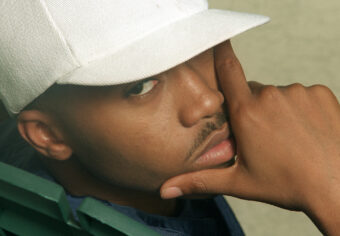

Dante “Mos Def” Smith walks the walk and talks the talk — literally. This past May, he led me on a four-hour interview ramble around Manhattan’s SoHo and West Village, stopping into bodegas and smoke shops, greeting fans, giving hugs and pounds, posing for cellphone photos, like the hip-hop ambassador of some conscious-rap dream sequence. But the Brooklyn-born MC, 35, is a knottier figure than such hail-fellow appearances imply. He’s a Broadway and Hollywood actor of subtly complex gifts (Topdog/Underdog, The Woodsman, Something the Lord Made); a fearless, if egocentric, tester of musical boundaries, often to the detriment of his own career (2004’s dodgy rap-rock hybrid The New Danger, 2006’s patchy contract-breaker True Magic); a pesky political provocateur; and a glib propagator of conspiracies and legends (yes on Bigfoot, no on the moon landings!).
He’s also just recorded the best hip-hop album of 2009 thus far — The Ecstatic, featuring kinetic, panoramic, global-pop production from Madlib, Oh No, Georgia Anne Muldrow, and French electro maven Mr. Flash. Whether rapping en español, airlifting Slick Rick’s “Children’s Story” into the Iraq War, or toasting a J Dilla beat with Black Star comrade Talib Kweli, Mos Def spits a call to prayer and party and bullshit with a fiery commitment unheard since Black on Both Sides, his late-’90s solo debut.
The Ecstatic‘s first single, “Life in Marvelous Times,” might be the most powerful and accessible song you’ve ever recorded — from storytelling to production — yet it’s not even being played on local New York radio.
If “Life in Marvelous Times” can’t get on the radio, then I don’t need to be on the radio. That’s how I feel. It’s over now. The radio is all around you anyway. The radio is everywhere and everybody [points at passersby], so let’s get the vibration going out. I’m very patient. People will hear it, although I know it’s hard for them to ignore all this shit that’s up in their faces. I mean, seriously, The Hills? No dis, but I mean — okay, fuck it, dis. Stop already. Why is anybody supposed to care?
“Life in Marvelous Times” goes back to when you were a little kid, nine years old, 1982.
That was the first year I wrote a rhyme, and it was also the year that I first saw Wild Style — in the theater, in the Bronx, with my moms. The place was packed. I lived for a summer in the Bronx, and you can’t really describe that time and the energy and have it mean all that it did. It falls short. New York was another type of place, and hip-hop was local, community music, public-access channel. It was a culture that came up in a city on the decline.
Didn’t you start acting when you were really young?
I was in my first play, Free to Be…You and Me, about the same time, when I was in fifth grade. I just caught the bug, and the magnet schools around my way had talent programs, and my mother was keen on getting me into them. And Philippa Schuyler, my middle school, was this place, this oasis, in Brooklyn, in Bushwick, in the hood, but there were all these bright, talented kids. It was like the Huxtables years before The Cosby Show.
You’re the eldest of 12 children and stepchildren — how long were the kids still coming after you were born?
From ’75 to ’97. We didn’t live together in the same house, but we were all close. And, yeah, we was working-class poor people. I never wanted for basics; we always had a place to stay, and my family’s a great family. But as you get older, you’re like, “Wait, this is not how the rest of the world is living.” Then, in the ’80s, [the television show] Dynasty came on, and we were like, “This is really not how the rest of the world is living. We are fucked-up over here. We’re broker than a motherfucker compared to this Dynasty shit.”
You grew up in a housing project in Bedford-Stuyvesant, the Roosevelt Houses. How much of an impact did that have?
I remember just spending hours looking out my window at the grass, this little fake-ass lawn you got. Sometimes, I’ll have recurring dreams about the projects, just staring out that window. I believe the projects were a social experiment; we were laboratory rats stacked on top of each other, and people just knew, inherently, that there was something wrong. There’s not a lot of regard for the property by the residents. Everything about it is just priming you to be institutionalized as an adult — the colors on the walls, the acoustics. My window didn’t even open up; you had to pull and push it out sideways to get some bullshit circular air going.
As a kid, did you question why you were living there?
Very early, I was like, we’re here because we don’t have any money. The racial aspect hadn’t even crossed my mind. I remember being seven years old and looking out that window, thinking, “I’m gonna make some money.” Because we were good people. It’d be different if we were creeps. But even creeps deserve to live someplace halfway decent.
By the time you got to high school, it was the full-on crack era.
When crack hit, you had people who couldn’t ordinarily afford cocaine now getting some for the same price they could get a nickel or a dime bag of weed, and it was just over. It was a wrap. You had 15- to 16-year-olds with $200,000 in their closets from hustling. Then you had dudes who wasn’t selling dope trying to get money from the dudes who was. If you have hundreds of thousands of dollars in that situation, you’re not going to take it to Chemical Bank. And if somebody takes it from you, you are not calling the police. You just got got.
With so many people buying dope, and so much money to be made selling it, you get mass craziness.
It was a lot of violence, and it was all young folks. You’d be at the bus stop and 30 dudes would run up and just beat the shit out of the whole bus stop, and then get on the bus and beat the shit out of the whole bus, including the bus driver. So you’re walking around in a state of constant stress. It was a wild time, man, and nobody cared. City didn’t care, government didn’t care. The Decepticons [a Brooklyn gang] were running around here with hammers. They’d show up at your school at 8:30 in the morning, you’re waiting to get in, and they’d fuck the whole school up — you, the security guards, your moms, whatever. There was no regard; school was dangerous.
Is that part of why you dropped out of high school? Or was it also that you were already booking acting jobs?
I’d been acting professionally since I was a freshman, and by my sophomore year, I’d discovered the phenomenon of high school ladies, and I was running around here in the Village, and the only reason I still went to school was for the arts. And then, in my senior year, I booked this job in L.A. [the sitcom You Take the Kids with Nell Carter]. I was going to school out there, but the show got canceled, and I came back. I’d met a girl — she was a couple years older than me, and I was pretty impressed with myself, so I was like, I’m not going back to school. It was a silly thing, but I really wanted to pursue my career. I’d also run away from home when I was 15.
But I thought you got along well with your parents?
I just wanted to do what I wanted to do, man. You know, my parents were busy, they were working all the time. My dad was in Jersey, my mother was in Brooklyn. My father’s got his kids, my brothers and sisters, and my mother’s got me and my other brother, and I was just like, I’m out, I’m out. I wanted to be in the streets, because there was an energy there that I wanted to be around. I was generally a quiet, obedient kid, but then I got into my teens, and I started questioning everything around me, and I just broke out. My parents were teenage parents, so they had a lot of struggles, man. I apologized to my mom later for doing what I did, but it was a vital experience for me.
And at that point, ’88 to ’91, say, if you were a kid in the city and you weren’t going out, you were missing a lot.
There was so much going on, so much creativity. And it wasn’t just hip-hop. You had the punk rockers over here, the whole house movement, which was this vibrant cultural thing, and the banjee boys, and all the hood kids coming through. It was all in Washington Square Park — that was ground zero for me. All the voguers, the House of LaBeija, the gay kids. It was a trip, and it was a scene that wasn’t happening in the boroughs — it was happening in downtown Manhattan, and it was like a breath of fresh air. It was like a whole other world. Everybody was listening to dancehall, the Soul Kitchen [club night] was bringing all the [funk] classics back, Sticky Mikes [reggae party]. It was a big scene, and I wanted in.
And you never wanted to go home.
I made a new home.
But when you got serious about rapping, you formed a group, Urban Thermo Dynamics, with your brother D.c.Q [and female rapper Ces].
In the early ’90s, when I really started to find my voice, I was reading a lot of books, and I was moved by the writers, like Chinua Achebe, and I wanted to be able to write rhymes that were as potent as what I was reading. Around ’92, ’93, my brother and me were watching Common Sense’s “Take It EZ” video on [local TV show] Video Music Box and he was like, “Yo, we could actually do this shit.” And we started going around to these talent shows, and at this one showcase, my brother met this guy from Payday Records who later signed us.
Did you think UTD was really gonna make it commercially?
Oh hell yeah, because we were seein’ the Fugees, and we was like a hood version of the Fugees! We had Showbiz & A.G. and Diamond D, great producers, and we was like, “We’re set!”
And you were still acting at the time?
Yeah, I was working with NBC on The Cosby Mysteries, living in Brooklyn, shooting on location in New York with Bill Cosby, meeting all these folks, getting off work and going to the studio. And then Payday shelved the album. And we had some internal group beef — they’re thinking I’m not committed because I’m busy with acting. But after that, I got a chance to meet De La Soul, and they helped put me on the map in a big way [guesting on their Stakes Is High album].
How did you and Talib Kweli form Black Star?
I’d done this 12-inch for [New York indie label] Rawkus, and they wanted me to do an album, and I didn’t want to, after the Payday experience. But me and Kweli were hanging pretty tough. He was working at [Brooklyn bookstore] Nkiru, doing open mics, and he was dope. He had this whole crew, and they were superscientifical. Their rhymes were dense, talking about Egyptology, these guys had the big brains! [Laughs.] Then one day, I bought this jazz album, I think it was Milt Jackson and Lionel Hampton, and I said, “That’s it, we need to do a collabo like jazz, a one-album deal.” I was big on being sovereign and free. And they gave us, like, $80,000, $90,000 to record, which was more money than we’d ever seen at one time. I’d just had my first child, and the goal wasn’t about trying to become a star, it was to become a real, working artist.
And then you guys became the symbol of hip-hop that wasn’t about bling and glitz or gangstas and hustlers.
Yeah, they had Bentleys and shit, and we weren’t necessarily mad at them for having Bentleys — that just wasn’t our focus. [Laughs.] It’s not like we were being holy rollers, but goddamn, don’t mislead the people. Don’t tell ’em they on the yellow brick road and then they crash into a brick wall. That’s just not necessary. We were far from perfect; we were out here on the streets like everybody, and we all could’ve gone down that road. But come on, man, crack was not glamorous, it was not sexy. You know, Japan in the ’40s got Hiroshima and Nagasaki, and the black community in the ’80s got crack. And that shit was like a mushroom cloud you cannot fuckin’ imagine. It destroyed many, many lives, and you see people living through that hell, you don’t wanna glorify that shit.
What do you think when you see artists still boasting about their material possessions during an economic crisis?
I mean, get as many diamond chains and fur pajamas and champagne breakfasts as you can, but the chains and pajamas and champagne can’t be the endgame — not for us. Reckless capitalism kills black people. This music has given young people in our community a dangerous road map, and at the end of it, if you don’t end up in some sort of trouble or grave, you may just end up a fuckin’ nut. Extended exposure to commercial rap has got to have some sort of negative psychological impact on you. It’s like, this shit is making me tense, this is not uplifting or relaxing, and I’m already living in an anxious environment. New drugs everywhere, violence is looked on as not that big of a deal, our leaders are sociopaths and thieves, the police hate you, and then you turn on the radio, and it’s like, pour some champagne on yourself! And how does that look to the rest of the world? To the rest of our neighbors in this country who don’t come from our communities? They’re like, these people are morons.
On The Ecstatic‘s intro, you have a clip of Malcolm X talking about meeting extremism with extreme methods and how he’ll join with anybody to make extreme change. How does that jibe with President Obama’s message?
Obama’s got an extreme fuckin’ message, if you ask me! Barack Obama is an extremist; do not be confused! [Laughs.] You have to be an extremist to believe that you’re gonna be the president of the United States and your name is Barack Hussein Obama! And he’s using extreme methods, but his application is very smooth. Michelle Obama is extreme, her presence is extreme. And it’s an extreme good. Extreme is not negative. There has to be an extreme departure from what we’ve been doing. There has to be extreme renewal.
You’ve been outspoken about how you don’t believe Al Qaeda is a primary threat to the U.S. Do you really believe that?
I don’t see the organization. I don’t see the dynamics. The PLO, Hezbollah, the IRA, even the Ku Klux Klan, they’re dynamic groups — they have a military arm, they have a public relations arm, they have writers. Al Qaeda, the way that they’ve been promoted through the media is that they’re in caves, but they got access to jumbo jets. They got laptops in rooms all over the world with credit cards, and they can hack anything and get a U-Haul truck on a moment’s notice. Who is the leader of Al Qaeda — the Riddler? This shit is not making sense to me. The other terrorists must be envious, like, these Al Qaeda niggas are just loose — they’re a real ragtag bunch!
What’s the first thing we should change about U.S. foreign policy?
America should deal with cleaning up its own house, and stop fucking with people, and stop pursuing its international interests with such disregard for how these people live, their cultural ties. It’s some crazy colonial invader, Ponce de León–type shit. “We’re gonna civilize y’all with Jesus and democracy and Chicken McNuggets. What is this you’re over here eating? Hummus? That’s some bullshit. Here’s some French fries, and let’s put some honey glaze on ’em. Now you rockin’!”
Do you feel like your views are too often misunderstood, like when you were on Real Time With Bill Maher questioning the threat of Al Qaeda?
This is supposed to be the land of the free and the home of the brave, but people ain’t brave out here. They don’t wanna upset the dinner table, and if you have a dissenting point of view, then motherfuckers just stop inviting you places. That’s why I’m glad I come where I come from, because I’ve got experience with being uninvited. That shit don’t stop my stride, that don’t bruise my ego or hurt my heart. I know what it feels like to have the door slammed firmly in my face, so I’m cool with that. I might not be good with you or Bill Maher or Christopher Hitchens, but I’m good in the hood, and that’s all I need to be.