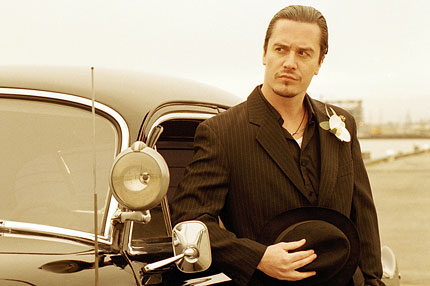
Three years ago, Mike Patton (Faith No More, Fantomas, Mr. Bungle, etc.) unveiled a new chapter in his work with a series of live concerts fronting a 30-piece orchestral unit billed as Mondo Cane (pronounced “Mondo Con-ay”). The name, plucked from a 1963 Italian documentary about bizarre traditions and rituals around the globe, means “a dog’s world.” But more to the point is that the movie introduced the Oscar-winning hit song “More,” whose soaring romanticism has become emblematic worldwide of a musical point in time.That time is Italy in the early 1960s, when Rome was one of the major film capitals of the world. Italian soundtrack music has enjoyed a renaissance of interest in recent years, long enough for collectors to become wise to the fact that many Italian film composers (Ennio Morricone, Riz Ortolani and Piero Umiliani, to name a few) got their start as tunesmiths and orchestra arrangers for Italian pop records.
Patton’s Mondo Cane is a rich and heartfelt celebration of Italian pop music, a special breed distinguished by innovative instrumentation, orchestral color, playful gimmickry (sea sounds, heavy breathing, gun shots) and, particularly in the case of romantic ballads, grand operatic passion. The heroes of this particular world are people like Gianni Morandi, Adriano Celentano, Don Backy, and the sublime Mina, not to mention any number of crossover artists who left their marks on this narrow but deep shelf of music, like Gene Pitney, Connie Francis, and Francoise Hardy. Patton’s long-awaited first Mondo Cane album (more volumes will follow) was just released on his own Ipecac Recordings, which has previously put out such Italian soundtrack compilations as Ennio Morricone’s Crime and Dissonance. (One of Morricone’s compositions, “Deep Down,” from the 1968 Mario Bava film Danger: Diabolik, is a highlight of Mondo Cane.)
All the lyrics are in Italian, but if you can accept Patton’s vocals as one of many instruments in a deliriously colorful stew, the words somehow convey their meaning through his virtuoso inflection. This is not a tribute album, but rather an up-to-date, impassioned, mouth-to-mouth resuscitation of a music of feeling that deserves to be better known internationally. And don’t expect it’s all sweetness and light: “Urlo Negro” (“Black Howl”) is as throat-stripping a number as anything Fantomas ever released.Here Patton, 42, speaks about the Mondo Cane project and his plans with the recently reunited Faith No More.
Mondo Cane adds another color to your impressive spectrum of musical expression. I’m sure you must get a lot of business counsel to be “just one thing.” How do you make a career of such diversity work for you?
No one has suggested I do just one thing for years. It wouldn’t matter. That isn’t something I would ever consider. As an artist, I would never let myself get boxed in. I’m a human being too and, like most humans, I have interest in many different types of music. I also get easily bored. There are so many ideas that I have in my mind, of projects that I would love to tackle, people I would love to work with, genres I would love to experiment with, and sounds that don’t fit any of my previous projects that I need to find a home for. I am constantly amazed at the musicians that are able to do the same thing over and over for 20 or more years. That would drive me absolutely insane.

The essence of Mondo Cane is the Italian pop song, circa the 1960s. How did Italian culture begin to assimilate itself in your creativity?
I lived in Italy for quite a while and married an Italian woman. While there, I immersed myself in the complete culture: the music, art, literature, film, food, and history. It’s easy to fall in love with. As a country, Italy does a good job of holding onto its rich traditions and culture. There’s a real lack of embracing history in America.
How did the music first grab you, via pop music or through film music?
Perhaps it first came to my attention via film music, but it really started to fascinate me when I started listening to all of the old Italian pop music. In the same way that people in America discover Sinatra, I started learning of all these historical musicians in Italy that created this beautiful emotive music.
All of this music hails from roughly the time you were born, or a little before. You’ve said there is”timelessness” to this music, but do you think it speaks to people differently now than it did in the ’60s?
Actually no, I don’t. I think that all great art stays great forever. I still think that the paintings you might see in a museum from decades ago are just as beautiful today. That is why I also don’t see the foreign language being a barrier in this music. No matter what the words say, or when they were written, and who originally sang them, these songs still translate wonderfully. Beyond the social or political ramifications of some music that defines an event or period of time, it seems to me that great musiccan stand the test of time.
What do you think it is about the present musical climate that makes people receptive to this music now? I’m remembering that the Euro soundtrack Vampyros Lesbos Sexadelic Dance Party topped the U.K. alternative charts in the 1990s, and you yourself released a Morricone compilation. And what, if anything, about this music do you think was prophetic or perhaps psychically displaced at the time it was recorded?
Not sure if any of this music was prophetic. It certainly is not considered hip by any means. But there it has been sitting for years, ignored by most of the rest of the world. I’m not sure if it can work commercially in today’s musical climate, to be honest. But that says more about today’s climate than about this music. Where would you hear this, or read about this type of music? Today’s climate is very stale. Driven by trends and oversaturation. Originality is not rewarded-that’s for sure. I don’t expect to see these songs on any sales or radio charts. I can only hope, as I always do, that people will give it a listen and form their own opinion. Don’t wait to read about the opinions of others. We are a culture now that is content to be told and force-fed the entertainment that we are “supposed” to like.
Obviously there is a wealth of material to draw from-and there are YouTube clips of a Mondo Cane concert from Amsterdam in 2008 where you performed more songs than are featured on the CD. How did you settled on these particular selections?
It was very hard. As a matter of fact, I have most of the material chosen for the next Mondo Cane record. I tried to make it a good sampling of the type of music I enjoy and also make it flow cohesively as a record. A few different moods and styles.
When I saw the video of your Amsterdam performance of “Deep Down,” I found myself tremendously moved and in ways I’d not been consciously moved by the original piece. It took your performance to bring the song into the present tense for me and show me how much I loved it.
Thanks, I hope more people feel the same and, in turn, go out and discover more. Morricone is a great example. Many people think of him only in terms of spaghetti Western music. But that’s just apinch of what that genius has created.
Could you talk a bit about the ways in which this music could sometimes be musically prescient? I am thinking of some Ennio Morricone scores that featured dissonant solo trumpet that sounded like Bitches Brew years before Miles Davis himself went there, and also some of the unorthodox orchestration-sitar and orchestra, for example-that ran parallel with what Brian Wilson was doing on Pet Sounds and Smile.
Well, I don’t think it is a secret that all musicians borrow things from others and/or are inspired by sounds that they have heard previously. I think quite a bit is subconscious. I also am not one of those people who looks down on that. However, what makes it interesting is, if you can take those sounds or ideas and mix them up to create something original and fresh. Anyone can sample Miles Davis or Bonham’s drums, but re-creating them in a different context is the trick.
So much of the charm of the original Italian recordings was tied up with specific, if little known, musicians like Alessandro Alessandroni and the great vocalist Edda Dell’Orso. How did you approach the question of to what degree to emulate their work and to interpret the music in a fresh way?
I have never been interested in karaoke. I always like to put my stamp on things. If I didn’t do that, then why bother? There’s a way to emulate something without copying it. Sometimes it doesn’tWork, but it’s way more rewarding to try. Most tribute records bore the hell out of me. It’s far more interesting to hear someone who has been inspired by an artist channel that artist using their own talents. There are lots of different ways to make lasagna, and more than one way can be great.
What do you see as the key to the timelessness of this music?
Not sure about that. The mood and feeling? I’m not one to look so deep into things like this. I just think great art is great art. And what might seem great to me might seem like garbage to someone else.
This is less a question than an observation. In 1988 I saw Faith No More open for the Red Hot Chili Peppers in Cincinnati. I don’t know if you were in the band at that time, but the Chilis’ bus broke down outside Cleveland and they were hours late to the gig, and Faith No More held the stage for hours, playing the most obscure B-sides and even commercial jingles just to pass the time. I was unfamiliar with the band at the time, but was impressed by their ability to harness so much pop culture musically. If you were involved in this performance, I thought it might speak to something in you personally, as a musical omnivore, that looked forward to a project like Mondo Cane.
Uh wow! I don’t think it was me, although we did some of that with Mr. Bungle, but I’m sorry to say I don’t see the correlation to Mondo Cane. I think it is a different type of pop. I think that situation was a little more tongue in cheek.
Speaking of Faith No More, are you and the other members surprised by the enthusiastic response to your recent reunion? Are you creatively satisfied to just revisit the older material or is there the possibility of recording a new album?
We have been very surprised by the strong reaction. We were told to expect it, but it goes beyond what we expected. It has been cool playing with the guys again. We don’t really have future plans. As you might expect, I’m more focused on presenting Mondo Cane to as many people as I can. As always, though, I’m very grateful for the continued support.
WATCH: Mike Patton, “Deep Down”
https://www.youtube.com/embed/zaUrzMeS4xg